
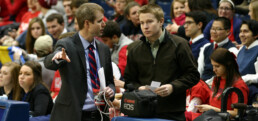
Sports Business 101- The Sports Information Director
By Matthew W. Maxey | Published Aug 5, 2015
When you tune in to watch your favorite college team’s latest game on television or read a story about them in the paper, do you ever wonder how the broadcasters and reporters are able to know so much about so many different teams? Is it because they spend every waking moment studying the rosters of every team in America? Are they calling and talking to coaches every night? Well, not exactly.
While many broadcasters and reporters aren’t afraid to do homework on the teams they cover, they also get a lot of help from some people who are rarely noticed or acknowledged – the Sports Information Director (SID).
Associated Press sports editor Teresa Walker, who covers both professional and college teams across Tennessee, described SIDs as “crucial” to her job. “Sports information directors keep me informed on a daily basis about what is going on with their programs.”
The role of the sports information director is multifaceted, meaning they have to be able to wear several different hats in their job, many of which they must wear at the same time. The overall goal, however, is to help promote the university and its athletic teams.
One local sports information director who has done just that is Greg Sage of Belmont University. Sage, who is in his ninth year as Belmont’s SID, has helped facilitate the Belmont athletics brand from that of a small Nashville college to a nationally recognized level. While overseeing all of Belmont’s 17 NCAA sports, Sage works largely with the men’s basketball program. He has seen the Bruins advance to college basketball’s biggest stage, the NCAA Tournament, six times during his tenure.
When casual sports fans hear this, it sounds like a dream job. They often envision it as hanging with their team in front row seats, keeping the stats and talking about the game afterward. In reality, it is much more than that. While there is a lot of interaction with the coaches and players, and the seats with a good view are rarely complained about, the two or three hours spent at a game are only a small portion of a “typical” day for the SID. The real truth is that there is no “typical” day in this job, and a 40-hour work week can easily be achieved by Wednesday or Thursday of each week.
“People often think of us as pencil pushers and stat keepers, and there is a piece of that in the job, but so much of what myself and others in my role do now is so new media oriented,” said Sage. “It now also includes audio production and editing, managing live video feeds and pitching stories to local, regional and national media outlets.” He added, “There is almost no difference than if I was an event planner for a music or sporting red carpet event.”
Like event planners, much of the work an SID does is completed well before game day even arrives. When Sports & Entertainment Nashville was on hand at Belmont’s men’s basketball regular season game against Murray State in February 2014, this game featured the top two teams in the Ohio Valley Conference and was aired to a national audience on ESPNU. For this game, like those before and after it, an SID will compile a new set of game notes and send those out to media outlets across the country who will likely be covering the game. Those notes will include research materials for media personnel like statistics, trends and individual player analysis, along with interesting notes on each player.
He will have also worked with local and national media, pitching stories for them to cover and coordinating times for them to attend practices and conduct interviews leading up to the game. In a town like Nashville that also features multiple professional teams and a wealth of other colleges all looking for media attention, this can be a rather time consuming effort.
When game day arrives, Sage and SIDs like him at universities around the country change the hat they wear countless times throughout the day. Prior to the Belmont vs. Murray State game, Sage spent time as a technical coordinator, helping television and radio crews prepare to broadcast the game. He also worked as a logistical coordinator, assigning credentials to media and photographers, assigning seats to those in attendance to cover the game. He also wore the hat of statistical coordinator, putting together a crew to keep the official stats for the night’s game, in addition to updating social media outlets throughout the game and coordinating the in-house video production to show the game and replays in the arena.
SIDs like Sage at schools the size of Belmont also must remain versatile because they have to cover so many different sports and treat each one of them equally. At Belmont, Sage is one of two full-time staff members, along with three graduate students. Contrast that with some of the larger BCS schools that may have five to 10 full-time staff members.
“There is a contrast between us and BCS schools,” he said. “They have a greater number of full time staff and more niche sport assignments, but they also sponsor more sports usually.”
Sage noted about his job that it is really a “hybrid, non-descript role. You have to be extremely versatile, not locked into just one or two skillsets and able to adapt.” Sage’s versatile background helped prepare him for the role of a sports information director. Having previously worked as a producer at The Golf Channel and as a sports anchor/reporter/producer at two television stations, he knows what reporters are looking for when they cover a team. He also still uses his broadcasting skills – during basketball games, he also serves as the color analyst for the Bruin Sports Network broadcasts with Voice of the Bruins Kevin Ingram.
So the next time you are reading about your favorite team or watching the game on TV and hear something new and interesting about your team, know that there was probably an SID like Sage behind the scenes helping to bring that information to you!
Originally published in Sports & Entertainment Nashville, May 2014.

Bobby Bones: Is he the new voice of country music or just your friend on the other end of the line?
By Matthew W. Maxey | Published Aug 5, 2015
A fact well known in Nashville, and throughout the music industry, is that country music has been undergoing a transformation for years. Many of the artists have a new look and a new feel, which means fans also have a different look and want to hear their favorite songs and artists introduced and discussed in a new way.
Enter Bobby Bones.
The Bobby Bones Show broadcasts on nearly 70 affiliates to nearly three million weekly listeners. Bones also hosts two weekend programs – Country Top 30 with Bobby Bones, on more than 100 affiliates, and FOX Sports Radio's Bobby Bones, on nearly 250 affiliates.
Just as David Allen Coe famously described the perfect country and western song, for decades many similarly envision the perfect country and western DJ as a deep voiced, cowboy hat wearing guy with his matching belt buckle and cowboy boots.
Bobby Bones is none of that.
He doesn't own a cowboy hat, or even a pair of boots, but that doesn't mean Bones isn't country. Sitting in the WSIX studio with his black rimmed glasses, and often a flat billed baseball cap, Bones discussed how the last year and a half where he and his co-hosts have taken the country music world by storm is far from his first introduction to country music.
"I'm from Arkansas; country music is what I grew up on."
Bones is host of The Bobby Bones Show, with his friends Amy and Lunchbox, which airs weekday mornings on nearly 70 affiliates to approximately three million weekly listeners, in addition to hosting the Country Top 30 with Bobby Bones on weekends that has more than 100 affiliates.
The native of Mountain Pine, Arkansas, not only grew up on country music but one could almost argue his youth could have been a country song. His mother had him when she was just 15, he doesn't know who his real father is and he was a self-described 'welfare and food stamp kid that moved from school to school and trailer to trailer.'
"We didn't know any different then," he recalled. "We thought everybody bought their school clothes at garage sales. I didn't know that we were struggling, that was just normal to us."
It was that difficult upbringing though that helped develop a determination and desire to succeed in Bones that is evident to anyone who is around him.
"Radio is really the only thing I've ever wanted to do my whole life; that and be a standup comedian and be on television. I don't really know what it's like to not know what I want to do with my life."
Bones got his first job in radio at the young age of 17 and after becoming the first in his family to graduate high school, attended Henderson State University. While there he worked for the campus radio station KSH 91.1 The Switch and met professor Richard Robinson.
Robinson, whom Bones has described as a father figure in his life, recalled his first encounters with Bones in class. "I could tell from the beginning he was very eager and very determined."
After graduating from Henderson State, Bones landed a job working nights at Q100/KQAR in Little Rock. While in Little Rock, Bones tendency to push the envelope was made most evident when he took over the airwaves of a rival station. His sidekick 'Gilligan' snuck in the rival station, patched Bones in by phone and he was able to broadcast on their air for 15 minutes before being caught.
"I almost got fired for that," Bones said. "But, that's also when Austin called. They were like, wow that's awesome, come work in Austin."
Bones had never been to Austin before but took the job only a few months after starting in Little Rock and now considers it one of the best decisions he's ever made. While there Bones got his first shot at the coveted morning radio time slot, now only at age 22, and The Bobby Bones Show, as it is known now was built.
Austin is where Bones met his now co-hosts, although they were not part of the show in the beginning. Lunchbox he met in a bar and Amy he met at a restaurant.
"We weren't like anyone else, we were having acts on that were alternative, hip hop, county – if you were good, you could come on our show. There was no rhyme or reason; we just wanted quality folks on the show."
Bones' and his crew's approach resonated with listeners and the show became widely popular. Seeing this, Bones wanted to syndicate the show, but management didn't agree at the time. That didn't stop the ever-determined Bones though; he just bought his own equipment and paid out of his own pocket to start the syndication process.
In 2012 Bones was approached by Clear Channel management about taking The Bobby Bones Show national. The catch though was that it would require moving to Nashville and switching to a country format.
"It doesn't matter where you put me, I grew up on country music and it is as easy for me as anything else is."
Moving to Nashville, locally Bones and crew replaced legendary WSIX host Gerry House, whose House Foundation morning show had long been one of the most popular in Music City.
The show also continues to welcome in guests of all music genres. The biggest names in country music, like Taylor Swift, Blake Shelton and Jake Owen certainly appear on the show, but performers like Ed Sheeran, A Great Big World or country rapper Big Smo are also just as likely to be in studio as well.
"I loved Gerry House so much," said longtime WSIX listener Christy Pratt. "Now someone new came along I had to adjust to new voices and new personalities. It was like starting a new friendship – you just don't really know them. Eventually though, through the personal stories they shared, I grew to know them and the friendship grew."
That engagement with the listeners has also allowed Bones to do a lot of good. After tornadoes devastated Moore, Oklahoma Bones was able to raise over $135,000 from his friends on Music Row and listeners. The show has also raised over $65,000 for St. Jude Children's Hospital in Memphis, $40,000 for tornado relief in Arkansas, and over $150,000 for 30Abes, a charity started by co-host Amy to benefit the Maison Des Enfants De Dieu orphanage in Haiti.
On air is not the only place Bones has raised money either. His band, 'The Raging Idiots,' have raised over $300,000 playing free concerts around the country, donating all the money to charity.
"I wouldn't say it's gratifying, but it's been fulfilling to know that I can do stuff to help. It is something I didn't expect, but something that makes the job just that much more worthwhile."
As the show continues to prosper, locally WSIX has quickly become not just the top country station in Nashville but the top station overall.
"Not wanting to be poor again and to make people laugh," he said without hesitation, when asked where his drive comes from. "There was never really an option not to succeed, so I've just kept working hard, showing up on time and being someone that people can rely on."
The humble Bones would never say he was the next big thing, but does admit, "This is going better than anyone thought it would, myself included."
Tags: Bobby Bones, Bobby Bones Show, Country Radio, Gerry House, WSIX
Baseball in Nashville… 1864 style
By Matthew W. Maxey | Jul 30, 2015
For years a favorite night at the park for Nashville Sounds fans has been their "Throwback Thursday's" when in years past they would don the classic blue and white uniforms that featured a man swinging a gigantic guitar. With the opening of the new First Tennessee Park on the site of the old Sulphur Dell park, Throwback Thursdays now feature the Sounds in the Nashville Vols uniforms of the 1940s.
Only steps away from First Tennessee Park though, you can see baseball thrown way back to the way it was played in 1864. The Tennessee Association of Vintage Baseball features 10 teams from across the state, playing the game by its original rules. This means, no gloves (because they hadn't been invented yet), no home runs (because they typically had only one ball and they didn't want to lose it), and pitchers who throw the ball underhanded because their primary responsibility was to give hitters a ball they could hit – not get them out.
The league, now in its third season, grew from just two teams in 2013. As people saw and heard about the vintage baseball, they began asking not just how they could watch it, but how they could join a team or form their own. Teams now dot Tennessee from Mountain City to Nashville.
Aside from having fun playing the game, the goal of the Tennessee Association of Vintage Baseball clubs is to promote living history by bringing the 19th century to life, with the hopes of providing educational programs and cultural enrichment to children and adults alike.
Players in the league range in age from 25 to 75, and come from all walks of life – everyday workers, doctors, state officials and even scientists. They each wear traditional uniforms from 1864, take on the persona of players from the time and play in traditional locations like Bicentennial Capitol Mall, Carnton Plantation and the historic Sam Davis home in Rutherford County.
The Nashville Maroons, one of the original two teams, play their home games at the foot of Tennessee's Capitol building at Bicentennial Mall, and on the day we took in a game against the Stewart's Creek Scouts, crowds of people were amazed to see a baseball game from 1864 breaking out. Few passersby were able to keep going without stopping to watch at least an inning or two, like a couple visiting from Germany who were visiting the State Capitol that day with their grandson.
The grandson made them stop and watch for a while, but at first he wasn't convinced it was really baseball he was watching. "I think it is baseball," he said to his grandparents repeatedly. "But it doesn't look like baseball I play."
That is a reaction players in the league have grown accustomed to, and with their intention of educating people young and old about the game and the time period in history, they do an excellent job of interacting with the crowd to explain the differences.
Just like in 1864, they aren't playing in confined stadiums like First Tennessee Park. There are no fences separating the players from the fans. There are other rules modifications from the game we know today, like if you catch a ball on the bound (one bounce) – that is considered an out, and for the most part the players make the calls on the field – not a slew of umpires. There is one official though, called the arbiter, who is there to settle any disputes if teams cannot agree on a call. In a truly interesting twist, if the teams and the arbiter cannot determine the outcome of a close play, the arbiter will turn to the crowd to settle the dispute.
The teams that make up the Tennessee Association of Vintage Baseball play games around the state through August, and will then culminate the season in a tournament for the Sulphur Dell Cup at the historic Carnton Plantation in Franklin.
In a world filled with fast paced weekends and non-stop schedules, take a step back to 1864 and enjoy America's pastime in its earliest form.
Tags: Barehanded Baseball, Nashville, Vintage Baseball
The American Junior Golf Association: Developing golf's next generation
By Matthew W. Maxey | Jul 25, 2015
Phil Mickelson…. Jordan Spieth… Tiger Woods… Rickie Fowler… Paula Creamer… Morgan Pressel…. and Nashville, Tenn.
One of these may seem to be out of place in this list, but Nashville and the top names in golf have a lot more in common than many know. Followers of professional golf in the Nashville area certainly know about the PGA TOUR success of local product and Vanderbilt alum Brandt Snedeker, who took home the PGA TOUR's $10 million FedEx Cup in 2012.
What many are not aware of is that before players like Snedeker, Mickelson, Woods and so many more became household names, they honed their competitive games as youths with the American Junior Golf Association (AJGA).
The AJGA has been called the PGA TOUR of junior golf by some as it is the most competitive golf tour for junior golfers in the nation and one of the most respected in the world.
Nashville has become an important leg of the AJGA's tour and the Toyota Music City Junior is played each year at Westhaven Golf Club in Franklin, drawing participants from over 15 states. Participants gain entry into the tournament either through points accumulated at other AJGA tournaments and prominent junior golf events, or through a qualifying round – similar to the PGA TOUR tournament qualifying system.
Snedeker credits much of his preparedness for professional golf to his days playing AJGA tournaments, saying, "It was great to kind of get a sense of what professional golf was going to be like. A lot of traveling, three and four round events, practice rounds, how to prepare and how to be ready for an event when it came time to tee it up."
Conducting national junior golf tournaments since 1978, the AJGA has developed a mission much larger than just providing an opportunity for junior golfers to compete against each other. The full mission of the AJGA is to dedicate itself to the overall growth and development of young men and women who aspire to earn college golf scholarships through competitive golf. In the last 10 years over 6,000 AJGA members have signed college golf scholarships.
"The amount of talent that is coming out of [Tennessee] now is phenomenal," said AJGA Southeast Regional Director Ryan Tahara. "It's really neat to see, and I think it has a lot to do with guys like Brandt Snedeker and Scott Stallings and their investment into the game of golf and growing it on the junior level."
At an AJGA Tournament, the participants aren't the only extremely talented people you will see. The AJGA is also home to one of the hardest working staff of professionals you'll see, and one of the most rigorous internship programs in the country. Each AJGA tournament is staffed by only a few full time employees along with a team of traveling interns that spend the entire summer going city-to-city around the country. When I, the author of this story, was an AJGA intern back in 2006, I traveled over 10,000 miles and visited over 21 states in only a four month span.
The AJGA's strenuous schedule and commitment to perfection in every aspect have made their staff and internship alumni very attractive to future employers. Alexis Witman, Communications Coordinator for the Nashville Predators, began her career with the AJGA as an intern and later joined the full-time staff.
"The AJGA does many, many things well, and one of those things is their internship experience," she noted. "I'm a firm believer that I wouldn't be where I am professionally without the time I spent as both a member of the AJGA's internship staff and as a member of the full-time communications staff."
If you get the chance to see the next generation of golfers up close at a Music City Junior, set your expectations high. The play on the course will be amazing and the environment produced by the staff will be reminiscent of a professional tour stop.
Tags: AJGA, American Junior Golf Association, Brandt Snedeker, Nashville Predators, Toyota Music City Junior, Westhaven Golf Club

Bringing up baby in a digital world
By Matthew W. Maxey | Published Jul 14, 2015
How to raise a baby in the digital era is a topic that, until recently, had never really crossed my mind. I was the guy that when I saw pictures of a friend’s children on social media would keep scrolling as quickly as I did past the latest Farmville request. It’s not that I dislike kids or anything like that, I just wasn’t in that stage of life yet and found other things more interesting than the bathroom habits of a three-year-old. That was until my wife and I learned that we were expecting a daughter.
After getting the news I was becoming a father, like most every first time parent does, I began reading up on everything I could find about babies. During all that reading I was struck by a post over at Knoxville Mom’s Blog about Protecting Your Kids from the Overshare Culture. A paragraph from the story that really caught my attention is the one below from one of the moms.

We were in the restroom at a local store when a lady, whom I know solely based off of social media, called my daughter by her first name and asked about the animals on our farm. My seven year old politely answered the question then posed one of her own: “How did you know my name?” “Oh! From Facebook, sweetie! I just love your pictures on there!” She dried her hands with a stiff paper towel and promptly left the restroom, leaving my seven year old daughter in utter confusion and a slight sense of worry: “How do strangers know who I am? What in the world is a Facebook?”
While my interest in the bathroom habits of my friend’s children remains very low, my awareness of their kids on social media is now as high as ever. I began taking notice of all the kids of friends and family as the popped up in my timeline and realized I actually knew far more than I previously realized about them – all because of Facebook and other social media sites.
That made me wonder two things. Could I unknowingly play the role of the well-intentioned lady from the excerpt above? More so though, how could I prevent my own daughter from experiencing a similar situation that could make her feel uncomfortable or frightened?
As someone who makes a living working with social media, and is active on several social platforms personally (I even started a Facebook page for our dog Maggie), I understand the desire to share the things you are passionate about. Now that our daughter is here, there is nothing on this earth that I’m more passionate about than her and my wife Ashley. Before I didn’t truly “get it” but now I fully understand why so many parents share the fun, exciting and especially the funny moments of their children online. They want to share the moments that mean so much to them with all their family and friends.
However, after reading many more articles on the subject and having multiple conversations with Ashley, I was reminded of something I have repeatedly told clients.
“You are your own brand and it is up to you to define what that brand looks like.”
With that in mind, my wife and I made the decision that we would make a conscious effort to keep pictures and excessive updates about our daughter off social media.
We were not overt about our decision, did not tout it as the only line of thinking, and by no means think anything less of our friends and family who do choose to post pictures of their kids on social media. In fact some of our favorite blogs are about the personal adventures of our friends and their kids. Like people make the choice between lacing up a pair of Nike or Adidas shoes, or playing a Titleist or Callaway golf ball, people can make the choice of what, and what not, to share about their children online and should be able to do so without judgement.
Our decision has been met with understanding from most and wonderment from others. Our families know about our wishes and are great about respecting those.
The reason we keep our daughter’s pictures off Facebook and other social sites.
- We don’t want to be “those parents.” On my Facebook page, I have close friends and family of course, but I also have a number of work colleagues, clients, acquaintances and those friends from high school and college you keep up with on Facebook even though you’ve not actually spoken in person for years. For a large majority of the audience viewing my Facebook profile, the simple fact is, my daughter is not very interesting to them. They don’t know her and they’re not hanging on a thread to know everything about her.
- These days you can find countless stories of kids’ photos being stolen from social media feeds and then being used in fundraising scams along with other far more unsavory ways. A very easy way to prevent that from happening to our daughter, is to not make those photos available to be stolen.
- The most important factor to us in making this decision though, was allowing our daughter to develop her own digital footprint when she is older – not inheriting one we created for her. When I was growing up, if someone saw an embarrassing photo of me it was usually because mom had cracked open the baby book again. My embarrassment was limited to a few people looking at an actual photo album, not an entire online audience of people who may or may not know me. Since Facebook didn’t arrive until I was in college, if you find something about me on social media it is because I put it there or was old enough to consent to it going online. I would like for my daughter to have the same clean slate as a starting point.
- Additionally, kids these days are growing up with their entire lives documented online from birth and will enter middle school with 10-plus years of material for bullies only a short Google search away. We all remember middle school and how little inspiration it takes for a bully to lash out. When most of us were growing up, that inspiration came from what we wore to school, the terrible haircut we thought was awesome at the time, or the fact we admitted liking the music of a boy band. It is a new world now with regular bullies and now cyber-bullies with their inflated keyboard courage. Our daughter will face enough challenges simply by being a pre-teen and going through the awkward stages we all did growing up. I’m certainly not going to make it easier for any of the bullies out there by putting 10 years worth of material on a silver platter only a Google search away.
How we still share our daughter’s fun moments with family and friends.
- Facebook and other social media sites are popular because they make it so easy to share information with a wide audience. However, you can also share privately to only approved recipients via the lesser used closed and secret groups that Facebook offers. My family has a “secret group” we utilize, meaning it can only be viewed by the invited members. This is where we do the planning for holidays, share family moments and occasionally talk a little trash about the annual Independence Day bocce ball tournament. Within this group, we do share occasional photos because they are not searchable by people we do not know and go only to those we wish to have them.
- We also have a Shutterfly Share Site for our daughter. Long-time Shutterfly users already, this was a no-brainer for us. Just because we don’t post them on social media, doesn’t mean we don’t still take a ridiculous amount of pictures of our little girl. Having a place we can store the pictures was nice, but the added feature of the share sites we love most is that you can share access to it with anyone you wish. All you need is their email. It also comes with a very easy to use mobile app, that allows you to sort the photos however you wish (we do ours by month) and gives you a photo album in your pockets at all time. This is a VERY popular feature with us and the very proud grandparents. If you want to have a hard copy of the pictures, you can also order prints directly from the app and of course from the Shutterfly website too.
“Where are the pictures of that cute little girl on Facebook?”
This is a question we got often right after our daughter was born, and still occasionally do, especially as many of our friends are still meeting our daughter for the first time. Occasionally friends will tag pictures of our daughter on Facebook thinking they are doing us a favor. We sincerely appreciate that they want to share those moments with us and make sure we don’t miss an instance of our daughter doing something cute. We know it comes from a good place in their heart with nothing but good intentions, and for that reason, when this happens we don’t make a big production out of it. We simply untag the pictures and politely or jokingly mention that she is not yet ready to make her world wide web debut. Our friends have been great about respecting those wishes and understand our decision.
What are your thoughts on posting pictures of your kids online? Is it something you pondered before your child was born and made a conscious decision about one way or another?
St. Jude Country Music Marathon: Celebrates 15 Years of personal accomplishments and making a difference
By Matthew W. Maxey | Jul 5, 2015 | Originally published in Sports & Entertainment Nashville, May 2014
The St. Jude Country Music Marathon & ½ Marathon has become a signature event for the city of Nashville. From its infancy in 1999 when it had just 7,500 participants, it has grown to a four-day event with more than 30,000 expected to lace it up each year. It now also includes a Mini Marathon of 2.6 miles plus a two-day Health & Fitness Expo and a Sunday brunch for those running as "St. Jude Heroes."
In the 15 years of the event, countless runners and visitors have not only helped boost Nashville's economy, but they have also achieved new personal goals and helped to support a number of worthy causes.
"To see the transformation over those years is just one of the absolutely thrilling things for somebody that's grown up in the sport," said Tracy Sundlun, Sr. of the Competitor Group which plans the event.
The race has had a tremendous boost to Nashville both economically and from a tourism standpoint. One recent race alone, which attracted over 30,000 visitors to the city, generated $38.2 million in economic impact, according to data provided by race organizers. Runners traveled from all 50 states and 26 countries to run the streets of Nashville.
Nashville Mayor Karl Dean is also excited about the success the marathon and half marathon have had in Nashville. "It sends a great message about Nashville trying to be a healthier, more active city. It's just all positive, and you can't beat having all these visitors come into our city."
When runners make the 26.2 mile trek through the city, they are greeted by a variety of live bands showcasing exactly why Nashville is Music City, USA – country, classic and punk rock, jazz and soul, all along the course.
While runners are traversing the route, many of them will have something else on their mind. The St. Jude Country Music Marathon & ½ Marathon is a fundraiser, and St. Jude Children's Research Hospital in Memphis is the primary sponsor. Their admirable goal is to raise the amount it takes to run the hospital for a single day. Many people run the race as a "St. Jude Hero," meaning they have committed to raise between $500 and $2,500 for the research hospital before even stepping up to the start line.
One participant who is anything but a marathon novice is Gabryelle Conklin, or "Gabby." Gabby is one of a set of triplets, diagnosed since birth with cerebral palsy, which confines her to a wheelchair. In 2009, ahead of starting high school, she told her mother, "Mom, I want to be a cheerleader!" That is exactly what she did – Gabby became an honorary cheerleader and was a fixture on the sidelines at her high school's football games for four years.
Gabby's story caught the attention of ESPN's "E:60," which profiled her in 2013. After the show aired, her mother received a call from Heath White, who had also been featured on the show for running races with his daughter Paisley, who has Down Syndrome. The two paired up to run the Marine Corps Marathon together in June 2013, finishing in 3:02 – fast enough to qualify for the Boston Marathon. Our hometown St. Jude Country Music Marathon has become one of their regular races together.
So while the St. Jude Country Music Marathon is certainly an economic boost for the city of Nashville, even more importantly, it also serves as a way for people to achieve personal goals and help those around them. For some, this marathon is the perfect vehicle to share their inspirational story of never, ever giving up.
Tags: Country Music Marathon and Half Marathon, Gabby Conklin, St. Jude, St. Jude Heroes
Sports 101: Westhaven’s Virgil Herring Sets Example of Modern Day Club Golf Professional
By Matthew W. Maxey | Published Feb 28, 2015
For anyone who has spent even a short amount of time around the golf course, you have likely encountered your club’s “head golf professional,” but what do you really know about what they do all day? Many still have the misconception that the club’s professional is the guy on the range most of the day giving lessons but is also the person selling the hats and shirts in the clubhouse and managing the social aspects of the club the rest of the time.
While that assumption had merit decades ago, the role of the golf professional has evolved as the game of golf has. The modern day club pro no longer oversees the merchandise in the clubhouse or worries if the carts are being cleaned each night – there are now club managers who work to oversee the inside and outside staff. Today’s “club pros” are more likely to be called directors of instruction and be PGA certified teachers of the game.
PGA professionals like Westhaven Golf Club’s Director of Instruction Virgil Herring do still wear many hats, but now all of them are focused on one set of goals – teaching and growing the game.
Instead of worrying if there are enough shirts for sale in the pro shop, Herring is spending his days teaching students the game in a state-of-the-art facility, through radio and through appearances on television. As the game continues to grow in today’s multimedia world, so must the teaching of the game. With his multiple teaching outlets, Herring is a prime example of what that looks like.
Herring has the opportunity to reach golf fans across the world as host of the popular radio program “Golf Talk America,” which can be heard daily on PGA TOUR Radio and Saturdays in Nashville from 7-8 a.m. on 104.5 The Zone. He also can be found on a television screen near you as a teacher with Golf Channel Academy, the instructional arm of NBC’s Golf Channel, and also as a regular guest on local NewsChannel 5’s “Sunday Sports Central” providing weekly golf tips.
The famed David Leadbetter is credited with beginning the move away from a do-everything club professional and into more of an exclusive teaching role. The game of golf has experienced tremendous growth in recent decades, and while, yes, the “Tiger Woods effect” helped draw many new people into the game, it has been the PGA teaching professionals like Herring who have helped develop the games of these new golf fans and fostered a level of skill that kept them coming back to the course week after week wanting more.
With the increased focus on exclusively teaching, how the game is taught has evolved tremendously as well. Those who took golf lessons two or three decades ago would hit balls on the range with one instructor giving them advice – then take it to the course and see if it worked. Now students at all skill levels are being helped with top-of-the-line technology, more focused research on the science of the game and from the increasingly important mental aspects of the game. The evolution of the way the game is taught has also led to the development of dedicated teaching facilities, like Golf Academy at Westhaven where Herring is based.
Inside the Golf Academy at Westhaven, you’ll find Herring at a teaching station that features multiple cameras and monitors to capture every possible video angle of a golf swing, along with Trackman Doppler radar that analyzes the swing and ball flight. You’ll also find a master club fitter to measure and fit golf equipment to the optimal specifications of each individual player, making Golf Academy at Westhaven a one-stop-shop for professional instruction.
Herring, who early in his teaching career was filming students on a standard VHS video camera then using dry-erase markers on a TV screen to show the planes and angles of a swing says of the technology advancements that, “it has changed my teaching career, for sure.”
Students of Herring can now see every detail of their swing from multiple angles and have tangible evidence of how specific changes affect their game both positively and negatively. With clubs that are fitted perfectly to them by Westhaven’s Master Club Fitter Tim Sygerych (who worked personally for six-time major champion Nick Faldo) and technology to guide their instruction, students are able rid their mind of other distractions and focus solely on the improvement of their swing.
For PGA teaching professionals like Herring, the sole focus on teaching the game along with advancements in technology has allowed him to have a tremendous impact on the future generations of golf. In his career, Herring has had 141 of his students go on to earn college golf scholarships. Many of those players have gone to major Division I programs, and Brandt Snedeker, his most notable student whom he coached from 2000-07, went on to be an All-American at Vanderbilt, PGA TOUR Rookie of the Year and the 2012 FedEx Cup Champion.
Herring doesn’t take much credit for the success of his students. He is quick to remind anyone who asks that he “didn’t take a single swing” to get them where they are. However, he is quick to share the joy he experiences watching each of them achieve their dreams.
What many don’t expect to be part of the golf teaching professional’s job may just be the most important for the modern day golfer. That is the job of being a part-time psychologist. Herring has spent a great deal of time studying the mental aspects of the game and differentiating the methods used in other spots that don’t necessarily translate to golf.
He says of his focus on the mental aspects of teaching that, “once we get past the physical elements, it is always the personal psyche, the self-image, of a person that limits them on how good they can be – because they have a self-stamped envelope of who they think they are and can be.”
He added that, “it has always been part of my teaching because I’ve always been trying to figure out why I didn’t make it. It wasn’t for lack of ball hitting or a desire to do it, it’s just that there are certain mentalities that work well in other sports but don’t work in golf.
“When you try to understand the differences in golf and other ‘reaction’ sports, it is totally different in how you have to have calm about you and not think about mistakes. Having a game plan to handle adversity and knowing that golf is a game of misses, not a game of perfection, and how well do you manage your bad shots and miss hits are what make you the best player.”
Given the advancements we have seen in recent years to how the game of golf is taught, Herring anticipates even more change going forward.
“I think it is going to get even more segmented. I think soon you are going to see there is a place that you go to get your swing work and a place that you go to get your mental work, and those may not be in the same place. It is going to get even more segmented, and as we have so much more information about every player that it is going to become very personalized.”
If the world of golf instruction does continue getting more segmented and specialized, one thing players around Nashville will know is that Herring will be ahead of the game and making sure his students have the best advantage possible to become the best player they can.
Pause those New Year's Resolutions, It is Restaurant Week in Nashville
By Matthew W. Maxey | January 19, 2015 | Originally published in Sports & Entertainment Nashville
The NFL's Super Bowl isn't for two more weeks, but if you are a fan of Nashville's growing restaurant scene this is your Super Bowl – it is Restaurant Week in Nashville. Over 35 of Nashville's finest restaurants offer special menus featuring three course meals during the twice-a-year event, sponsored by Nashville Originals.
It is an opportunity to try a variety of new eateries, as well as some of the traditional staples, around Nashville's growing food scene without having to fork out an arm and a leg to do so. If the abundance of choices overwhelms you, here's a week's worth of suggestions.
Monday — Jackson's, 1800 21st Ave S. Start your week off with a laid back dinner in Jackson's cozy, yet hip, dining area. Start with the Spring-Rolled Quesadillas, Shrimp & Grits for your entrée, and close with the Cookie-Dough Egg Rolls – one of the best desserts in all of Nashville.
Tuesday — The Yellow Porch, 734 Thompson Lane. Tucked away in Berry Hill, start with the Sweetwater Tennessee Sharp Cheddar Fritters, try the Coffee Brined Smoked Pork Chop, and finish with Banana Foster's White Chocolate Bread Pudding.
Wednesday — Jimmy Kelly's Steakhouse, 217 Louise Ave. When you want a great steak in Nashville, Jimmy Kelly's is the place – filet mignon with baked potato, finished with their famous Tennessee Blackberry Cobbler.
Thursday — Sole Mio, 311 3rd Ave S. One of the great fine Italian places in Nashville – start with the "Mista" salad, try the Ravioli Aragosta (lobster ravioli), and finish with their famous tiramisu.
Friday — Holland House, 935 West Eastland Ave. Start with the Sweet Potato & Ginger soup, followed by pork brisket with sautéed spinach and garbanzo, and finish with the Bourbon Pecan Cake.
Saturday — Germantown Café, 1200 Fifth Ave North. Start with the French Onion Soup, and for your entrée go for the Plum Pork – guaranteed not to disappoint.
Sunday — The Bunganut Pig, 1143 Columbia Ave (Franklin). A true southern meal to finish out Restaurant Week – fried pickles, a bowl of chicken and sausage gumbo, Buffalo Chicken Sliders, and a fried Twinkie for dessert.
Tags: Nashville, Restaurant Week, Sports & Entertainment Nashville
Your guide to the New Year's Day bowl games
By Matthew W. Maxey | January 1, 2015 | Originally published in Sports & Entertainment Nashville
The confetti from the New Year's Eve party has been cleaned up and the resolutions have been made, so now it is time to settle in for kickoff on a day full of football and the first-ever college football playoff. Here's what to know in each of today's games.
Outback Bowl — Auburn vs. Wisconsin. If you like old-school, ground-and-pound football, this is the game to watch. Auburn had a shot at a national title coming into the season, but the nation's most brutal schedule was too much to overcome. Wisconsin's Melvin Gordon was inexplicably AWOL for its Big Ten title game with Ohio State.
Cotton Bowl Classic — Michigan State vs. Baylor. There may not be a better defensive coach in the country than MSU's Mark Dantonio, and the same could be said about his Baylor counterpart, Art Briles, and his offensive genius.
Buffalo Wild Wings Bowl — Missouri vs. Minnesota. Perhaps no two teams were more underestimated, week-in and week-out, than these two. Missouri chose the path less traveled in this era of offensive wizardry (defense and special teams) to win the SEC East.
Rose Bowl, College Football Playoff Semifinal — Oregon vs. Florida State. The Oregon defense, which struggled big-time earlier in the year, is now playing at an elite level, making the Ducks a scary matchup for anyone.
Sugar Bowl, College Football Playoff Semifinal — Alabama vs. Ohio State. The Crimson Tide have the best coach perhaps in the history of college football, and a wide receiver in Amari Cooper who is about as unstoppable as any who ever played college football. But with a third-string quarterback leading the way, the Buckeyes just posted the most impressive victory any college team posted this season.
Tags: College Football, New Year's Day Bowls, Sports & Entertainment Nashville
Sports 101: The NFL Beat Reporter
By Matthew W. Maxey | Published Oct 29, 2014
Many people envision the life of a NFL beat reporter as someone with great seats at games and amazing access to the players and coaches of America’s top sport. While on the surface both of those statements are true, the day-to-day grind of a beat reporter’s life is far from being highlighted on the next episode of "Lifestyles of the Rich and Famous."
As the 2014 NFL season kicked off we sat down with two of preeminent voices on the Tennessee Titans, Jim Wyatt and Paul Kuharsky. Both are veterans of the industry that have seen it grow and progress over the years, especially with the addition of social media. The pair lets us take a look into the day-to-day grind, while also discussing the evolving role of a beat reporter in today’s new media world and what some of the common misconceptions of the job are.
Jim Wyatt – The Tennessean
Wyatt, a graduate of The University of Tennessee but proud Vanderbilt Commodore fan, has been the lead Titans beat reporter for The Tennessean since 2000. Wyatt began his journalism career at The Tennessean as a part-time employee before becoming the preps coordinator in 1997-98. He then began covering the Nashville Predators and Titans both in 1999 before moving to the Titans beat full time. Wyatt also appears on 104.5 The Zone’s afternoon show 3HL every Tuesday for an hour to discuss the Titans.
Paul Kuharsky – ESPN.com & MidDay 180
Kuharsky, a Columbia grad, is widely known to Titans fans, currently serving as the team’s reporter for ESPN.com, while also co-hosting the popular radio show, MidDay 180 on 104.5 The Zone weekdays from noon to three. Previously Kuharsky was the Titans beat reporter at The Tennessean and prior to that covered the Raiders for the Oakland Tribune and worked in the Washington bureau of the New York Times.
What would you consider the definition of a beat reporter today?
WYATT: When I think of a beat reporter, I think of someone who just lives, eats and breaths anything to do with the team they cover. Unless I’m on vacation or trying to take some time off, my job is to keep up with what’s going on with the Titans and to keep fans informed with what’s going on with the team. It used to be just doing that through the newspaper and writing stories, now its 24/7 on Twitter, writing blogs for the website and shooting video.
KUHARSKY: Well, I’m not it. [ESPN] calls us team reporters as they have 32 people in these roles, so I’m ESPN.com’s Titan’s reporter but I’m not a beat reporter in the sense that I’m chasing everything and trying to be first on everything. Jim Wyatt is a very good friend of mine and as good a beat reporter in the NFL as there is in the country.
In your time in the industry – How has the job evolved, especially with the introduction of social media into everyday reporting now? Do you see that as a positive?
WYATT: It is a completely different animal than it used to be. The biggest thing that’s changed is obviously just the 24/7 aspect of it. Everything is immediate. You spend most your day writing for the web and with Twitter, which is 24/7; you can never relax to be honest with you.
KUHARSKY: More so than ever it is constant. You could have a great scoop and it could last no time. Everything is incremental. It’s one of the unfortunate things about the pace of "news" now, but there is no putting it back in the box.
When did you realize just how much Twitter was going to change how sports were reported?
WYATT: I remember when the paper went to turning the focus to online and that was an adjustment, then I remember first hearing about Twitter and getting an account around 2009. You’ve got to pay attention and get news up on Twitter as fast as you can.
KUHARSKY: I think it was pretty early. I was in relatively early, ESPN was in relatively early, but there was no point or a certain story that showed me.
How much pressure do you feel on a daily basis to break news or be the first to report it?
WYATT: I think certainly you try to do your best to break news as much as possible. You can’t break everything but I am certainly realistic in knowing the world is completely different than the way it used to be.
KUHARSKY: You were expected to break news and it was a big deal if someone else broke news on your beat. A guy like Jim [Wyatt] probably doesn’t get as much credit as he deserves for being the guy through which 95% of Titans news comes out.
What is the biggest misconception about being a daily beat reporter?
WYATT: That it’s all fun and games. People hear that you cover the Titans and they think you get to go on road trips, go to the Super Bowl and you get to watch practice all the time. It is also a lot of work and there really is no offseason.
KUHARSKY: That you are buddies with the people you cover is a big misconception. I think most of the guys I have long term relationships with, I have professional relationships with.
What is your favorite or most satisfying part of your job?
WYATT: I’ve covered the Titans for 15 years now and I’ve just enjoyed meeting people. The players, the coaches, front office people, just a lot of really good people and having a lot of really good stories to tell as a result.
KUHARSKY: It’s hard not to say feedback. Hearing from people on Twitter or who call in and say they enjoyed reading something, or learned from reading something.
What is the most frustrating part of the job?
WYATT: Probably the time that goes into it. It’s really time consuming being 24/7, you can’t ever really take a break unless you’re on vacation.
KUHARSKY: Right now I’d say it’s the Twitter thing, where people can’t even click on the link. Dealing with people who just don’t understand what you do or why you do it.
Is there another team, in any sport, that you would like to cover on a full time basis?
WYATT: It is hard to say, working for the Tennessean I’m on the beat people pay the most attention to which is good and bad. I think I’ve got the dream job.
KUHARSKY: I’m beyond that. I’d love to cover the US National soccer team. The NFL is the best thing to cover with the one game per week.
Belmont's Betty Wiseman: It wasn't about being a pioneer, but rather opportunities and sharing
By Matthew W. Maxey | October 29, 2014 | Originally published in Sports & Entertainment Nashville
Betty Wiseman is a pioneer of women's basketball at Belmont University without question. The numerous awards and Hall of Fame inductions alone confirm that, but what those accolades can't show is her enormous heart and desire to share opportunities.
"This is not all about me, but how God has orchestrated my life. He has just blessed me so much for the opportunities that I've had. Belmont has been so good to me, Belmont has allowed me to pursue my dreams and try some different things."
Wiseman's basketball career began at Portland High School in nearby Portland, Tenn., where she led her team in scoring five consecutive years. She then enrolled at Belmont and after earning her degree in 1965, was quickly named Associate Professor of Health and Physical Education the following year.
In 1968, four years prior to the passing of Title IX legislation, Wiseman approached Belmont president Herbert C. Gabhart about starting a women's basketball program. Belmont agreed. "The little girl inside of me that hadn't gotten to play enough still wanted to, so at the time it just seemed like the right thing to do."
It wasn't easy in the early days – the new women's team could not practice until the men's team had finished up each day. "If the gym wasn't available until nine or 10 at night, then that was when we practiced." In that first year, with a limited number of players, Wiseman even suited up as a player-coach for part of the season.
Wiseman also began hosting basketball camps for local middle and high school girls. One player who passed through her camp was a young Pat Head Summitt. "Who Pat was as a coach, was who she was as a player," Wiseman said.
In her 16 years of coaching, Wiseman led her teams to a record of 248-152 and played in four consecutive National Women's Invitational Tournaments from 1973-1977. Her coaching earned her induction into the Belmont Hall of Fame at just 37 years old, and in 2004 she became the first Belmont coach or student inducted into the Tennessee Sports Hall of Fame.
"It is the players," she said, of what she looks back on most fondly. "They are my girls, they are my family."
When her coaching days drew to a close, Wiseman made a seamless transition into administration, becoming an assistant athletics director and senior women's administrator, helping guide Belmont's transition from NAIA to NCAA. It was as an administrator that two of her greatest passions came together – her faith and her love of sports – leading to the formation of the Sports Evangelism Team in 1992, which has since traveled to places like Poland, Costa Rica, Portugal, Venezuela, Brazil and Malta.
"The most gratifying thing of my career is watching the transformation of students in general, from the time they come to Belmont to the time they graduate. It's all about people for me."
While many know her as a pioneer on the basketball court and for women's athletics, anyone who has spent time speaking with Wiseman knows there is much more. She is an example – of doing things the right way; the honest way, the Wiseman way.
Tags: Belmont, Betty Wiseman, Pat Head Summitt, Women's Basketball
How ESPN College Gameday Got Started and How Big & Rich Became Part of the Brand
By Jessi Maness | Published Sep 2014
An interview with Lee Fitting, senior coordinating producer for ESPN's college studio shows, and our friends, Big & Rich.
If you're a college football fan chances are that every year since its inception, you've probably caught ESPN'S College Gameday show. If you catch it on a regular basis, then you not only know who Lee Corso, Chris Fowler and Kirk Herbstreit are, it's likely you also know the duo of Big & Rich.
According to Big Kenny, many times when he and John are traveling together people approach them in airports and say: “Hey – you're the guys who do ESPN College Gameday!”
But how in the world did Big Kenny and John Rich – world-renowned recording artists – become part of the ESPN College Gameday Brand?
Before we answer that question, whose idea was it to start ESPN College Gameday? And how did this college-game-day review show ever get started anyway?
To answer these and many more questions, we checked in with Lee Fitting, senior coordinating producer for ESPN's college studio shows and a 16-year veteran of ESPN production.
Fitting begins: “We actually started out as a 15-20 minute review. Then that expanded to a full half hour, and in that time we'd talk about the games each day and try to predict what would happen that afternoon or night. Then Chris Fowler had the idea [in 1993] to take our setup to an onsite location. So we went to the biggest game of the year that year: Florida State against Notre Dame. We took the whole setup and did a pre-game show from Notre Dame and it was great! That's how it was born…but it was a very small-scale show in '93.”
Each year after that, Fitting says the ESPN crew would take the “show on the road” three or four times a year. Then seven to ten times a year - until finally, eventually, it was on the road week after week during the season.
And how did they choose the games?
Fitting says around 2004 they just started going out every week to different campuses and would try to find the best game or best story of the day. Fitting informs: “We'd try to think ahead a little thinking like, 'Number 2 with Number 5 will likely be a sexy game, or a great story like a military academy or a division 2 and a division 3 game would be great' – to educate viewers on the types of rivalries out there. At some point, grew into a 3-hour show…into a massive monster.”
What's up with Corso and the mascot head?
Most Gameday viewers wouldn't miss the end of the show when Lee Corso dons the head of the college mascot for his prediction. Fitting laughs and gives us the scoop: “Corso was an original member and on game day we don't tell the guys to do anything. This mascot came about in…maybe 1996. It was at Ohio State and Kirk Herbstreit's wife was a former Ohio State Cheerleader. At some point, Herbstreit turns to Alison (his wife) and asks if she can get Corso the mascot headgear? And it worked out great. And just overall, Corso has probably done more for the popularity of college football than anyone in college history.”
When did you realize that ESPN COLLEGE GAMEDAY had made it?
“When the appetites just continued to grow and kids were camping out overnight to see the show and see the guys, relates Fitting. “When we'd go to the same school more than once in a year and the crowds kept growing…and when we went from 90 minutes to two hours then to three hours, we realized how big it had become. Because the passion of the guys who do the show – they're genuine, not fake, its not made up, it's not acting…they're the real deal. And their chemistry is once-in-a lifetime sports television chemistry.”
When did the celebrity guest aspect get started?
Fitting enthusiastically recalls: “When Charles Barkley first did it - it was probably ten years ago – he was the first one on the show. He was a big Auburn fan. He picked the games and was great at it. So it was probably about 5 years ago when we decided on doing it (celebrity predictions) every week. We had Lance Armstrong, Bill Murray, Bo Jackson, Olympian, Lolo Jones (American track and field and bobsled athlete), Darius Rucker (recording artist), and Bubba Watson (two-time masters winner.) And Kenny Chesney was one of our originals. And he'd do game predictions and he was great at it – and we've used Kenny more than one time and the fans love it.
And how did Big & Rich become part of the ESPN Brand?
“Big & Rich got involved when we heard their song, “Coming To Your City,” and got the idea to customize it and use the college [team] names…and it quickly became the show's anthem.”
Big Kenny (Alphin) asserts: “One of the things I don't know if people notice - about that song – is that this is our third iteration of it. We've written the lyrics now three different times. It's always the teams that are out there rocking it that end up in the lyrics. I think there are sixteen different teams that we've put into the lyric this year.
John Rich adds: “Which is quite a homework assignment to make them rhyme…”
“People ask what the number one condition of the team being in the song is, and it's that it rhyme, says Kenny. “It might not be the team name; it could be the stadium name, the town, the city, and anything they're known by. We get creative.”
Jokingly, Rich continues: “For instance, this new version says 'Well we rolled right through Death Valley, Boomer Sooner, Gig' Em Aggies” because Aggies doesn't go with Tomahawk Chop and it never will.”
In 2011, the song “Coming to your city” was reworked specifically for ESPN Gameday again – but that time, complete with a rap from Cowboy Troy. This year, Lizzy Hale from Halestorm, Travie McCoy and Cowboy Troy are all part of the show's theme song performance.
“It's really a Musik Mafia feel because you've got different genres and different singers all on the same 90 seconds. It's so cool and…people will be pretty pumped to see the new blood in on the song and feel how hard it rocks,” says Rich.
What is especially intriguing about Big & Rich is they are not only a part of the ESPN College Game Day brand they each have their own individual brands as well.
How multi-faceted is the Big & Rich Brand? We can start with the fact that they are “Big & Rich,” a world-renowned musical-duo with such a unique vibe that many have tried to emulate their harmonic stylings. (Their most recent duo album was released this past September).
Big & Rich are two [of four] founders of the Muzik Mafia– an organization whose mission is to encompass and promote talent of all genres and advocate for all styles of creativity - musical and non.
Big Kenny has his own musical brand called “Electro Shine” - electronic dance music coupled with country overtones, while John Rich has his Redneck Riviera lifestyle line officially released back in March and designed to reflect the laid-back, carefree beach lifestyle.”
John Rich, via his appearance and win on Celebrity Apprentice (in 2011) raised over $2million for St. Jude. He also supports multiple charities local to Nashville - like Vanderbilt Children's Hospital - as well as many national/international charities. He is an advocate for our U.S. troops and does all he can to see they are never forgotten.
Big Kenny has a mantra: “Love Everybody.” It is a part of everything he does and everything he believes in. Kenny has been to multiple countries to aid in the building of homes, schools, offer his services as a volunteer in times of crisis and much more. He has raised money for the Red Cross, United Nations Foundation, and Little Kids Rock, a charity that offers free instruments and rockin' lessons to kids in underprivileged public schools across the county.
Rich sums up the relationship between himself and Big K: “We've always been two distinct individuals and as a duo we make some interesting music and have a great friendship. When you separate the two of us and we're doing our own thing, he's [Kenny's] always going to be lighting a rocket and so am I. That's what we liked about each other in the beginning, was to see this other guy that was lighting as many rockets as I was and vice versa. We said, man, we should put our rockets together.“
Lee Fitting agrees that not only did they join rockets, they've added a bit of a rocket to ESPN'S Gameday as well. “They bring a great energy to the show. They've done a great job rewriting the song for the show and they were a great addition as far as we're concerned.”
Things are going pretty well considering ESPN College Gameday has won an Emmy for the best sports show on television. Not too shabby at all.
But remember, the SEC has just launched it's network. Does ESPN College Game Day have anything to worry about as far as ratings go?
According to Fitting, he has no concerns at all. “Anytime there's an appetite for more college football on television, it's a huge positive for the sport and a huge positive for college sports.”
We know you all are going to keep on watching ESPN College Gameday – right? Raise your hand if you're saying “right,” because I can't hear you. (Okay, even I admit that was corny.)
So, what's next for the show? “The beauty of Gameday is that you really never know what is next…the next week, the next year or the next. But our viewers like the unpredictability of the show. One thing I can tell you is that we tweak the show a little each year to try to improve it. I can also say I don't think we'll see the show expanding in time, not past the three hours. We've kind of taken it upon ourselves to be educational and entertaining and we're trying to be real. If we can always do that, I think we'll be around for a long time.”
The Road to the Show Goes Through Lipscomb’s Stephen Marsh Stadium
By Matthew W. Maxey | Published Jul 21, 2014
EDITOR’S NOTE: FYI- You, I and all fans of the English language know “Bisons” is not the proper plural usage of the term in standard usages, but the university makes a point to refer to their teams that way...They even took a campus-wide vote once to agree on using improper English!
Getting the call…
Making it to the show…
Being called up…
It doesn’t matter what you call it, every young boy that has put on a glove or stepped into a batter’s box has dreamed of getting that call to the show and officially becoming a Major League Baseball player. For many Bisons who played their collegiate ball at Lipscomb’s Stephen Marsh Stadium, that dream has come true.
Over the years, 27 Lipscomb baseball players have had their names called in the Major League baseball draft, and three of them have fulfilled that ultimate goal of suiting up for a major league team. Bo McLaughlin became the first Bison to reach the major leagues. The Houston Astros drafted the two-time All-American with the No. 14 overall pick in the first round of the 1975 draft, making him still the highest draft pick over for a Lipscomb player.
McLaughlin, a right handed relief pitcher, spent four years with the Astros before going to the Atlanta Braves for one season and ultimately finishing his career with two seasons on the hill for the Oakland Athletics. His career almost came to an abrupt halt in 1981 while with the A’s, when Chicago White Sox hitter Harold Baines hit a line drive back into McLaughlin’s face, breaking his cheekbone and eye socket in five places. After fears he may not make it through the night, and multiple surgeries, he returned to the mound only four months later in September of the 1981 season.
In his time in the league, McLaughlin made a total of 156 appearances, 21 as a starter, striking out 188 and carried a career ERA of 4.49. A distinction of McLaughlin’s still etched in the record books is that he is still No. 2 all-time for career plate appearances without a hit. While not uncommon for pitchers to not be great hitters, McLaughlin made 45 consecutive plate appearances without a hit, which was only bettered by the New York Mets’ Randy Tate with 47 during the 1975 season.
After his playing days, McLaughlin went into the real estate business before finding his way back into baseball, this time as a pitching coach. Over the years he has spent time as a pitching coach for the Chicago Cubs, Montreal Expos, Baltimore Orioles and now the Colorado Rockies. With the Rockies he worked with their pitchers through the minor leagues for years before being named the Rockies co-pitching and bullpen coach in 2012.
As pitching coach for the Rockies, McLaughlin has had the unique opportunity to coach Rex Brothers, one of Lipscomb’s only two other major leaguers. Brothers was drafted No. 34 overall by the Rockies in 2009 after then roving pitching coordinator McLaughlin had scouted him. Brothers spent two years in the minor leagues before making his major league debut for the Rockies in 2011. He became a regular out of the Rockies’ bullpen, then in 2013 moved into the team’s closer role after injuries knocked out then-closer Rafael Betancourt.
Brothers finished 2013 with 19 saves, posting a 1.74 ERA and even had a 30-inning scoreless streak. Brothers’ success has continued this season, including tossing an immaculate inning. Against the San Francisco Giants in June, Brothers struck out three batters on only nine pitches. It was the first time the feat had been accomplished by any Colorado Rockies pitcher in history, and the first time it had ever happened in San Francisco’s AT&T Park.
McLaughlin said of coaching the fellow former Bison that, “He’s outstanding, you know what I mean? It’s always a pleasure to go ahead and work with somebody like that. He’s got a lot of dedication and a lot of desire to be the best he can be.”
After Brothers was drafted in 2009 his Lipscomb coach, Jeff Forehand, said at the time, “I think this is going to show kids that if they come to a smaller school they will be on the mound early. They will pitch for three straight years and if they improve, Major League teams are going to find them. As we go forward from here Rex has set the bar high. Hopefully, we will have more of them in the years to come.”
Little did he know at the time, but that message wouldn’t just hold true for future Bisons, but also for family members of Rex Brothers. Adding to the Colorado Rockies stable of former Lipscomb talent, in 2013 they drafted Bisons junior Hunter Brothers – yes, he is Rex’s brother – in the 24th round.
The younger Brothers decided to return to the Lipscomb for his senior year but in early June the Rockies came calling again. Colorado drafted Hunter a second time, in the 30th round this go-round, and he joins his brother and McLaughlin in the Rockies organization.
Time will tell if Hunter ultimately joins his brother and McLaughlin in the ranks of former Bisons to ‘get the call’ to the majors, but someone who doesn’t have to worry about that call coming anymore is Caleb Joseph.
Joseph, a fixture on the 2008 Atlantic Sun championship Bison team, was a seventh round draft pick by the Baltimore Orioles. After seven persistent years working his way up through the minor league system, Joseph got the news he had always wanted in a rather unique way. While with the Triple-A Norfolk affiliate of the Orioles, Joseph recalls getting chewed out by his manager Ron Johnson for talking to players on the other team during batting practice.
Little did Joseph know at the time though was that it was a ruse by his normally stoic manager. Johnson said as punishment they were going to ‘scratch [Joseph] from the lineup that night, and furthermore they were going to send him to Florida tomorrow.’
That was when it hit Joseph, because the Orioles were in Florida at the time taking on the Tampa Bay Rays. “I lost it at that point,” Joseph said of the moment. “I was like, that is not how I dreamed about it, but it was great. It was a good moment.”
Joseph’s new manager, the legendary Buck Showalter was very eager to get Joseph up to the big league club. “He's kind of been a steady climber,” Showalter said of the right-handed-hitting catcher the night of his major league debut.
Showalter added, “He really wants this. For a lot of guys it gets tough to keep girding through and improving. He's gotten a little better each year and he one common thing, pitchers really like throwing to him. This is a big moment for him and he deserves it.”
In Joseph’s first game with the Orioles, he went 0-3 at the plate, but just a few short days later at historic Camden Yards he registered his first major league hit. Later in June he hit his first major league home run, at Yankee Stadium, and since has become a regular in the Orioles lineup. In August Joseph found him name in the headlines after belting home runs in five consecutive games, something accomplished by only one other player this season. His improved play to close out the season also earned him a spot on the Orioles post season roster.
When asked in an interview what it meant to join Brothers and McLaughlin as the only Lipscomb players to play in the major leagues, Joseph had this to say.
“Really good, and since I’ll be the first position player because Rex and Bo are both pitchers, that’s quite an honor. When I was young I use to go to [Lipscomb] games, I’m like a third generation there.”
Joseph added, “When I went there I had such a great experience with Coach Forehand and all the staff, and then to be able to kind of be a part of history is a real honor.”
With Brothers and Joseph both on active rosters in the majors, the bar Coach Forehand was speaking of in 2009 has certainly been raised, and shows that it was no fluke that major league talent is being developed at Stephen Marsh Stadium.
Uniquely, on the diamond isn’t the only way that former Bisons have found their way to the big leagues either. Casey Bond, who began his baseball career at Birmingham-Southern, transferred and played his final season at Lipscomb after Birmingham-Southern dropped Division I sports. In that lone season with the Bisons, Bond registered the tenth-most hits and third-most stolen bases in program history for a single-season.
His performance on the field made him a 25th round draft pick of the San Francisco Giants in 2007 and he played in the Giants minor league system for two years. After being released in 2009, rather than signing with another team, Bond began pursuing another dream – acting. He moved to Hollywood and within six months found himself back on a baseball diamond again, this time though in his first movie role as Chad Bradford in the star-studded film “MONEYBALL” along-side Brad Pitt, Jonah Hill and Philip-Seymour Hoffman.
In addition to an appearance on ABC’s ‘NASHVILLE,’ Bond has also starred in the baseball themed movies ‘Ring The Bell’ and ‘Undrafted’ which is expected to be released later in 2014.
While other programs in Nashville, like recent NCAA National Champions Vanderbilt, have a number of high profile MLB prospects year in and year out, they are certainly not the only program in Nashville sending guys to prominence on the sport’s grandest stage.
Live in 3, 2, 1…SEC Network Set to Launch!
By Matthew W. Maxey | May 7, 2014 | Originally published in Sports & Entertainment Nashville
The Southeastern Conference, arguably the biggest brand in all of college athletics, is preparing to get bigger – much bigger. In August, the SEC will officially launch the new SEC Network, changing the landscape in which fans consume information and watch their favorite Southern teams both on television and online.
"The SEC Network will provide an unparalleled fan experience of top quality SEC content presented across the television network and its accompanying digital platforms," stated SEC Commissioner Mike Slive during a press conference to announce the network.
The SEC, in partnership with ESPN, will launch a 24/7 broadcast network and online digital platform featuring more than 1,000 live sporting events per year – 450 televised on the network and 550 distributed digitally. Games that previously aired on regional networks like FOX Sports South and CSS will now all be available on the SEC Network and its digital platform.
The network will originate from ESPN's Charlotte, N.C. offices, with additional staff located at ESPN's Bristol, Conn., headquarters. ESPN's Justin Connolly will oversee the network's day-to-day operations.
"I am thrilled to have this opportunity," Connolly said. "It is a great honor and a great responsibility to be part of this initiative. Our aim is to bring the passion and the identity of the SEC onto the screen."
In its first year alone, the SEC Network will carry 45 football games, including weekly triple-headers during the 13-week regular season, plus a traveling pre-game show called "SEC Nation" hosted by Joe Tessitore alongside Paul Finebaum and Tim Tebow. Legendary broadcaster Brent Musburger and former Florida quarterback Jesse Palmer were announced as lead commentators for football games.
"I'm delighted to be staying with ESPN, thrilled to be able to call the best football conference in the nation every week," Musburger said in a statement.
Beyond football, the network will also carry more than 100 men's basketball games, 60 women's basketball games, 75 baseball games and 50 softball games, along with extensive coverage of the SEC's 21 different conference championships.
As part of the agreement creating the new network, ESPN and the SEC agreed to extend their existing media rights agreement through 2034 – keeping ESPN partnered with the SEC for the next 20 years.
Tags: ESPN, SEC Network, Southeastern Conference
Collegiate Track & Field Programs Around Nashville: Full of History and Leading the Way
By Matthew W. Maxey | Published Feb 2014
When people think historically about sports in Nashville, that history didn't just start when professional franchises like the Tennessee Titans and the Nashville Predators came to town. The Music City has been turning out top athletic talent for as long, or longer, than the Grand Ole Opry has been turning out country music legends.
There have been generations worth of great football and basketball players that have come out of local universities like Vanderbilt, Belmont, Lipscomb and Tennessee State and gone on to professional success and even Hall of Fame careers. There have also been hundreds of great baseball players dating back to the 1860s, who either got their start in Nashville or at one time stepped up to the plate at the old Sulphur Dell ballpark or Herschel Greer Stadium.
Many people, though, don't realize that track and field has a very rich history in this town. At Tennessee State University, they have been producing some of the top track and field talent in the world. Much of that success is due in part to one man, Edward Stanley Temple, who served as head women's track coach at Tennessee State from 1953 to 1994.
During Temple's 44 year tenure, he guided his famed Tigerbelle teams to 34 national titles. While at Tennessee State, 40 of his athletes became Olympians – including five for countries besides the United States. They won 23 Olympic medals, 13 of them gold. Temple himself was the head coach of Team USA for the 1960 Games in Rome and the 1964 Games in Tokyo, while also serving as an assistant coach for the boycotted 1980 Games in Russia.
Temple's Tigerbelle teams have produced some of the most famous names in US Olympic history - names like gold medal winner and Clarksville, Tenn., native Wilma Rudolph, along with gold medal winners Edith McGuire, Wyomia Tyus and Chandra Cheeseborough, just to name a few.
In a truly remarkable feat at the 1960 games in Rome, seven members of the U.S. women's track and field team all came from Temple's Tennessee State team. That Olympiad saw Rudolph run into the record books by capturing gold in the 100 and 200 meter races. She then became the first American woman to win three gold medals in the same Olympics when she anchored the winning 4x100 relay team, in which all four participants were Tigerbelles from Tennessee State.
Tyus, now a U.S. Olympic Hall of Fame member, became the first sprinter – male or female – to repeat as Olympic champion in the 100 meters, winning in both 1964 and 1968. Her repeat performance also meant that for three straight Olympic Games, the fastest woman in the world hailed from Tennessee State.
In those 1960 Games, right behind Tyus in the 100 meters was Tigerbelle teammate McGuire, giving Tennessee State the two fastest women in the world that year. McGuire collected a gold medal of her own later in those Games, winning the 200 meter race.
The Tennessee State program was also about more than just producing quality athletes and future Olympians. In a true testament of perseverance and strength, Temple was able to produce these dominant teams of African American women year after year, in the racially divided South and well before Title IX came into existence. Temple was determined to nurture his teams into becoming quality citizens as well.
During Temple's induction to the U.S. Olympic Hall of Fame in 2012, Tyus recalled in an interview that “To me, the Tigerbelles are everything that I could see a woman should be. It was not only that they were great athletes, but they were also women that were doing something to make careers for themselves when they were told 'no,' and also to be black women and in the South, there were a lot of hurdles to get over.”
Speaking of those hurdles, she added that Temple often reiterated, “You just have to keep doing what you need to do.” She says he would also often add, “And even if you do that, you could go to the Olympics and win three, five or six gold medals and you may not ever get the credit you deserve. And it's not about that. You need to get an education, so that's what the Tigerbelles are all about. You go to school, you run, yes, but your main goal is to get a good education and be what you want to be.”
Through the years, Temple helped guide his Tigerbelles through the classroom with almost equal success as, of his 40 Olympians, 39 graduated with a college degree.
“And really, when I sit back and look at it now, I'm just as proud of that as if they won the gold medal,” Temple says. “I had 28 get their Master's, and 13 or 14 got their MDs or Ph.Ds or Ed.Ds.”
The Tigerbelles had more than challenging social environments to overcome in their college careers. The training itself was a challenge in more ways than one. As was evident through his athletes' Olympic successes, Temple was very good at teaching the Tigerbelles to run, despite difficult training situations. Even though he was producing world class athletes, the Tigerbelles had anything but world class facilities to train on. At times leading up to national championships of U.S. Olympic Trials, his teams would practice three times a day – at 5 a.m., 9:30 a.m. and 2 p.m. on an old cinder track.
“And, brother, when it's 2 in the afternoon here in July, it's 90 or 95 degrees,” Temple said. “They had to put tape on their knees and tape on their fingertips to get down on their mark with the cinders so hot.”
Indoors, they would work out on the basketball court, which made it difficult to prepare for the indoor tracks they would be competing on.
Temple coached his last Olympic gold medal winner in 1984, when Chandra Cheeseborough became the first woman to win gold in both the 4x100 and 4x400 relays at the same Games. Fittingly, when Temple decided to retire from coaching at Tennessee State in 1994, it was Cheeseborough, now Cheeseborough-Guice, who took over the reins of the program.
Since taking over, Cheeseborough-Guice has continued the winning ways by leading the Tigerbelles to six Ohio Valley Conference Track and Field Championships and has been named OVC Coach of the Year four times. She has also followed Temple's lead and was named the sprinter's coach for the 2008 U.S. Olympic Team and helped guide Team USA to 23 medals, 10 of which were gold, at the Beijing Olympics.
Clearly, the deep rooted history in track and field has helped inspire future generations of Tigerbelles, but the work of Temple and runners through the years has also set the bar tremendously high for the other NCAA Division I teams in Nashville.
Belmont and Lipscomb are both relatively new to the arena, having only joined the Division I ranks a little over 10 years ago, but the competition successes for both have improved with each season. Vanderbilt has been competing in SEC track and field since 1989, and, in that time, they have reached the NCAA Championships as a team nine times, finishing as high as 14th in the 1997 outdoor championships and 15th in the 1998 indoor championships.
A quick look at the Vanderbilt team's facilities also shows exactly how far women's track and field as a whole has come since Temple and his Tigerbelle teams were training on cinder tracks and basketball courts. The Commodores outdoor track facility underwent a $1.7 million renovation back in 2003, which made it one of the finest running surfaces in the Southeast.
That pales in comparison, though, to the brand new multipurpose facility that houses the track and field team's indoor training facility. Leading the way in what is expected from indoor track facilities in today's NCAA, the $30 million dollar project includes a six-lane, 300-meter indoor track, training room and video board for hosting home events.
Commodore head coach Steve Keith said of the new facility that, “now we are able to host an SEC level championship and have a winter home. It was always a limitation for us in the winter outdoors. In January and February when we are competing indoors, we would have to do it outside. Now we are looking forward to having a home with consistent training and for recruiting it has been phenomenal.”
With historic staples of excellence like Tennessee State's women's track program and others improving and making continual strides like Belmont, Lipscomb and Vanderbilt, it is very reasonable to expect that Nashville will certainly continue to impact the future of track and field in years and decades to come.
Nashville’s Female Sportscasters: Always On Their Game!
By Matthew W. Maxey | Published Feb 2014
Nashville was the site of the biggest event in women’s athletics this year - the NCAA Women’s Final Four. As a result, a lot of attention has been given to the efforts of women competing in athletics. During the lead up to the Final Four, one of the NCAA’s “legacy programs” highlighted the issue of women working in sports media.
This is a topic that has been discussed on the national level for some time. We turned to our local female sportscasters and sportswriters to learn about them, how they got into the industry and how their experiences have related to some of the national headlines.
Teresa Walker – Associated Press Sports Editor
Readers across the state of Tennessee have been familiar with Walker’s writings as the Associated Press Sports Editor for years. She has been with the AP in Nashville since 1989 and is responsible for coverage of the Titans, Predators, Memphis Grizzlies and college teams across the state.
Dawn Davenport – WKRN & ESPNU
Viewers in Nashville have known Davenport since 2008 when she joined WKRN. She spent six years covering sports full time, having won “Best Sportscaster in Tennessee” in 2011 and 2013 before making the switch to WKRN’s “News 2 This Morning.” She didn’t leave sports altogether, though, as she began her first season as a sideline reporter for ESPNU’s Saturday night primetime college football game of the week.
Audra Martin - WKRN
Martin is the newest name to the Nashville sports media, joining the WKRN sports desk in August 2013 to fill the spot vacated by Davenport.
What made you want to become a sports reporter?
Walker: I’ve just always been a tomboy and watched sports. I grew up watching the Cubs when we lived in Chicago, and after we moved to Nashville, I watched the NFL on Sundays with my mom.
Davenport: I grew up in a sports-oriented family. My dad was a walk-on basketball player at Duke, and my mom has always been really into sports. My brother and I were outside playing sports all the time growing up, and I played volleyball in college at Auburn. [Sports] were just what we did for fun! In college, I ended up with a mass communications major and am really lucky that I fell into what I’m meant to be doing. It wasn’t really until college, though, that I realized I could make a career out of it.
Martin: I grew up a sports fan, which was odd because neither of my parents were sports fans. I also grew up playing sports, but my entire life I thought I was going to grow up and be a police officer. It wasn’t until my first semester at the University of Central Florida as a criminal justice major that I ever thought of it. I made a 4.0 that semester, and the university sent me a letter saying because of my grades I might be a fit for some of the restricted majors that were offered, and the television program was one of them. When I read that letter, something just clicked, and I decided to change and become a broadcast major.
How did your career path bring you to Nashville?
Walker: I started my career at The Daily Times in Maryville and for two and a half years was covering school boards and police beats. I got to cover everything but sports. Then when I got to AP, I started off covering college basketball and football by phone, because that’s how we covered it back then. Then I got the chance to start writing sports fulltime for AP, and it was amazing.
Davenport: I spent two years in Wilmington, N.C., and then moved to Richmond, Va., for a few more years before moving here to Nashville... It is such a great place that you fall in love with and just don’t want to leave since it is such a great town.
Martin: After I graduated from college, I actually decided that I didn’t want to pursue a career in journalism. Instead, I decided to try and do something more behind the scenes on the media or PR side. I flew out to the Major League Baseball winter meetings in Las Vegas on a whim and went to the job fair. I actually got multiple job offers and ended up taking a sales position with the Atlanta Braves, thinking it would be a foot in the door. It took all of five months for me to realize I missed television and I couldn’t get it out of my head. After shadowing the Braves broadcasters for one day, it solidified that I had to pursue television.
I began working with the Atlanta Thrashers. In my second year, they needed a fill-in rink-side reporter, and it was a dream come true. The ironic thing, though, was that the next year the Thrashers were sold and moved to Winnipeg. When the team left, I made it my goal to get back into broadcasting. While I was looking, I actually worked behind the scenes on “Family Feud” for two years.
I had a great time working there, but it was always in my mind that it wasn’t sports broadcasting. Then one day, [“Family Feud” host] Steve Harvey said, “You can never have ‘Plan B,’ because if you have ‘Plan B’ you are subconsciously telling yourself it is okay to fail at your dream. If ‘Plan A’ fails, you make another ‘Plan A!’” After that, I sent my resume tapes out all over the country and ended up getting a job in Huntsville, Ala. I was there less than a year before WKRN called, and two weeks later I was here in Nashville.
Does sexism exist in today’s sports media world? How do your work experiences here in Nashville compare to other markets you have worked in or visited?
Walker: I have been very lucky. I think working for the AP helps; it’s a name that is recognized and is a national standard, so I’ve not run into those issues. That said, I’ve been married for 17 years, and I think that having a wedding ring on helps. Dealing with the Titans, they have been great. I’ve never run into any issues when I’ve gone down to Memphis to cover the Grizzlies or Tigers, and the same with the Predators. It really is refreshing. When I hear stories from other women in the industry, I’m really sad for them because I have not run into that in Tennessee. It is a market that has not had a lot of women in it over the years, but largely I have just been “one of the guys.”
Davenport: I have personally never been treated any differently being a female in this business, ever. Maybe I have been lucky, but as a female in the business you just have to know exactly what you are talking about and be knowledgeable, then you won’t be treated differently. As far as senior leadership positions, maybe there aren’t as many females as we would all like at this point, but I can say I have never been treated any differently in any locker room or covering any sport.
Martin: [Sexism exists] to an extent, but I think it is getting better. You are never going to get away from it; it just comes with the territory. Sports have been a man’s world, and, being a woman in that world, you just have to work that much harder. I like always having to prove myself, though, because it just makes you work harder. In Nashville I haven’t had any problems. Everyone has been friendly, and I think a lot of that was because of Dawn - I came to a place where there had already been a female in this role and laid the path... In Huntsville, I was the first female sportscaster at my station. The people, viewers and players have all been great in Nashville, and I’m incredibly grateful.
You are all active on Twitter and other social media outlets. Do you ever get tweets or messages related to your appearance or gender instead of your reporting? How do you respond if you do?
Walker: I get some…Back during the NFL conference championship games, I tweeted out my picks, and I had someone respond back with an inappropriate name. Thank goodness, though, there is a block button. If you call me names, you get blocked. I don’t really converse with them much, because when you start out a conversation with some names, there just isn’t a conversation to be had.
Davenport: I don’t get a ton of it, but occasionally. During football season, I got a tweet that said, “Great report. Now get back in the kitchen,” but, honestly, I think you would get that in any profession. There are unfortunately people in our society that don’t think women belong in the workforce, and there is nothing we can do to completely eradicate that. I think it is something you just get used to. You do your job, and maybe one day you can change their mind.
Martin: In Huntsville, I got a viewer email that said, “Call me a bigot, call me sexist, call me whatever you want, but there are certain things I don’t want shoved down my throat, and your female sportscaster is one of them. I’m old school and I want my sports news delivered from a man.” I’ve also gotten my fair share of requests for dates and pickup lines on Twitter, but they have never really bothered me. You just have to take it with a smile.
When younger girls ask you about becoming a sports reporter, what is the first piece of advice you give them?
Walker: Anytime I see a woman who is in journalism and thinking about sports, I try to help them because when I was growing up I saw Phyllis George on the CBS “NFL Today” show, and that was the only woman I saw. I try to help them any way I can and also refer them to The Association for Women in Sports Media, which is a networking ability that women didn’t have when I was coming along.
Davenport: It isn’t easy! I made pennies and just scraped by in the beginning. It is over 40 hours a week consistently. For those that think it is just “stand in front of the camera and look pretty,” it is definitely not. It is a lot of hard work and a lot of research. If you want to be in this profession, you have to be constantly learning and ready to work!
Martin: You have to be prepared to work harder than the guys, and you can’t be scared to ask questions. Also, if you want to do this, you have to have faith in yourself and you can’t be scared of rejection or moving to a small town. Otherwise, eventually you’ll be like me and be 28 years old and realize you could have spent the last five years of your life doing what you love instead of jobs that were just okay.
Women playing and working in sports has been in the spotlight with the NCAA Women’s Final Four in Nashville this year. What would you like for people’s primary takeaway to be from all the added attention this year?
Walker: It is nice that the Final Four is coming to Nashville, but there are women working here in the state. We could probably use some more, and I would say if you are female and looking to get into sports then give it a shot because there is definitely room for growth.
Davenport: There are a lot of people who don’t give women’s athletics a chance, and these women are phenomenal athletes. I think if they would just give it a chance, they really would enjoy it.
Martin: That we aren’t going anywhere! We are willing to work as hard as anyone else and embrace it, because there are some incredibly talented women athletes. They deserve the same respect the guys get!
Women Can Talk Sports: Changing What It Means to Be a Female Fan
By Matthew W. Maxey | Published Feb 2014
For Taryn Foshee, a Mississippi State graduate, former Miss Mississippi and top five finisher in the 2007 Miss America pageant, sports have always been a part of her life. She grew up playing different sports and going to MSU games with her dad. Now a Nashville resident, she has set out to change what it means to be a female fan.
It wasn’t until she moved to Nashville and completed a public relations internship at Country Music Television in 2007 that she began thinking about how she wanted to do something that would help other women. She knew she wanted to do something - she just wasn’t sure how yet. She continued on with her professional life, going into medical sales for the next five years, all the while carrying with her the thoughts of doing something more for women.
“Working in medical sales, I saw that being able to talk about sports allowed me to develop relationships quickly in what is largely a male dominated industry,” Foshee recalled. “I knew that other women should have this opportunity, too, but for many of my girlfriends, it wasn’t as simple, as no one had ever talked to them about it.”
While working full time in medical sales, Foshee was also obtaining a Master’s Degree from Vanderbilt University. Her thesis research was in Sport Sociology, with an emphasis on how to create more space for the female fan in sport culture.
With ideas that had been building for five years and now with a clear path shaped by her education, Foshee started the “Women Can Talk Sports” website in 2012. It was going to be the place for any women who had ever avoided talking about sports because they “didn’t understand” the game or didn’t have anyone to answer their “silly questions.” Foshee set out to develop a community where they could comfortably learn about the different sports and find answers to those “silly” questions.
“I had a passion in my heart and knew I should be doing something with this,” she said. “I just had to start writing and putting it out there, because I knew there are women who can benefit from what I’m learning and teaching myself about sports - other women need to learn this too.”
She did just that, posting blogs not just about the basics of baseball, basketball and football, but also about major events and news items in the world of sports as well. She also encouraged women with recommendations on how they can “win in the workplace” with sports and avoid being intimidated by reminding them of what she always says. “You don’t have to know everything. You just have to know something.”
It wasn’t without trepidation, though, that Foshee launched “Women Can Talk Sports,” and she relied on her previous pageant history to get started. “My pageant years really taught me perseverance and how to put myself out there,” said Foshee, who competed in the Miss Mississippi pageant four times before winning it. “Knowing that people were going to be judging me and what I write, that gave me the confidence to start the blog. I told myself, ‘You’ve done this before and survived. So just go for it!’”
After the launch of the “Women Can Talk Sports” website in 2012, the response was immediately positive. Foshee began hearing from readers saying how they now, for the first time, understand what a first down was. Moms were printing off lists of player positions and basic formations and taking them to their sons’ football practices to better understand the plays.
After the early success, Foshee then began speaking at “lunch and learn” sessions and “ladies night” gatherings. She has been asked to speak on a number of panels to educate women not only about sports but also how they can use that knowledge in their personal and professional lives.
The website and blog have been such a success that, at the start of 2014, Foshee made the leap and left her stable job of medical sales to become the first full time employee of Women Can Talk Sports.
Since doing so, Foshee has continued to build a community of women engaged in the sports conversation. That community grew even more at a party on Selection Sunday for the NCAA Tournament when “Women Can Talk Sports” launched an app that lets female fans connect from wherever they are. Foshee hopes the app will allow female fans to upload pictures, have discussions and expand that community for any level of fan to talk freely.
Foshee and “Women Can Talk Sports” also hope to reach those female fans who say they don’t care about sports. “Usually that means she doesn’t care about what happens on the field or court, but being a fan is about so much more. There is always something we can connect with whether it’s a player, a storyline, or the social aspect of attending or watching a game.”
With the successful start of “Women Can Talk Sports,” it is clear that Foshee is doing every day exactly what she dreamed about - empowering women to join the sports conversation.
NCAA Women’s Final Four – The Stage Is Set for Nashville
By Matthew W. Maxey | Published Jan 2014 | Originally published in NASHVILLE Sports & Entertainment Magazine
The women’s basketball world will turn its eyes upon Nashville in April 2014 for its premiere event of the year, the NCAA Women’s Final Four. As a region that has a long-standing legacy of enthusiastic support of women’s basketball at all levels, Music City was selected back in November 2008 as the Women’s Final Four destination, with the Ohio Valley Conference (OVC) and Nashville Sports Council serving as co-hosts. Preparations have been in the works ever since for Nashville to host the showcase event of the women’s basketball year. Now that the event is only a few months away, the city and organizing committee are ready to take the stage and put on a first-class event.
While basketball fans already know that the Women’s Final Four coming to Nashville means that a new national champion will be crowned in Bridgestone Arena, they may be surprised at everything else that also will be coming to town as part of the Women’s Final Four festivities. Even more so, they may be surprised at just what it will all mean to the city.
The NCAA boasts the Final Four weekend as “More Than Just Three Games.” Throughout the week of the Championship, a number of events will be happening in conjunction with the games, all of which are projected to generate more than $20 million in economic impact for Nashville and leave a lasting legacy for years to come.
“We want this to be the best Women’s Final Four ever, and there is a strong commitment from the organizing committee to do just that,” said OVC commissioner Beth DeBauche, who is heading up the Nashville Local Organizing Committee (NLOC).
Aside from the games that make up the Final Four, the annual Women’s Basketball Coaches Association (WBCA) Convention with its 2,000 coaches and 3,000 attendees will be occupying the new Music City Center during the Final Four and will bring coaches from all three NCAA divisions together to openly discuss how to continue growing the women’s game.
Fans of the Final Four teams will also descend on the city, and, while here, they will be greeted with a “Tourney Town” setup that, in true Nashville fashion, will feature concerts from national recording artists, pep rallies, youth clinics, fan contests and giveaways. There will also be a “4Kay Run” held in honor of the late North Carolina State coach Kay Yow, with proceeds benefiting cancer research through the Kay Yow Cancer Fund.
Additionally, before the college stars take the court, the future stars of the game will be on display as well. The WBCA High School All-America Game will be played at Bridgestone Arena the day before the Final Four begins, showcasing the top high school basketball players in the country. A rare chance to see these players before they achieve college success, this game will be free and open to the public.
Outside of the games themselves, the largest aspect of the Final Four weekend will be the “legacy” programs, designed to make a beneficial and long-lasting impact on Nashville’s youth.
“Our legacy campaign is much larger than what you have seen in other host cities,” commented DeBauche. “Our commitment is two-fold for young people. For the young student-athletes participating, we want this to be a phenomenal event they remember for the rest of their lives. For the young people in our community, we want to leave a lasting legacy.”
While most host cities in the past have embarked on one or two legacy programs, the OVC and Nashville Sports Council will be tackling five legacy programs. Each will have the goal of showing young people ways to get involved in the many different aspects of the game, but they all will aim to help young people improve themselves personally in the process.
There will be a “Champions for Women” program that will pair area students with local female business leaders who will mentor them and help train them in leadership skills. The program will culminate with a luncheon where participants and their mentors will hear from prominent speakers and meet with local leaders.
The “Middle School Madness” project will promote the arts and methods to help promote arts in local schools, while the Adventure Science Center will be leading an educational program titled “Science of Swoosh,” where the science of the basketball shot and other aspects of the game will be explored.
A “College Futures Forum” will take place to educate students and their parents about the importance of college, how to get prepared for higher education and what steps to take if they wish to become student-athletes like the ones competing in the Women’s Final Four.
Finally, there will also be a legacy project titled “Media & Women.” It will discuss the portrayal of women in sports and will also discuss multiple methods of getting more coverage for women’s sports, including print, online, radio and television aspects. In addition, there will also be a student journalism program that will allow student reporters to cover the Final Four.
The Final Four coming to Nashville isn’t just a boost for the images of the city, the Nashville Sports Council, and the OVC - many of the local colleges in the Nashville area will be on display as well. Our colleges and universities will be playing host to events and youth clinics on their campuses, sponsoring events around town or simply lending their knowledgeable staff for the operation of the tournament.
While speaking about the benefits of the Women’s Final Four coming to Nashville and the involvement of the area colleges and universities, Tennessee State University’s Athletic Director Teresa Phillips said, “We are all going to be sponsoring some type of event that will give our universities a little juice to build up what we do as an institution and as a city. It is a major event, and everyone will have an opportunity to benefit from it.”
Also on display during the Final Four will be Nashville’s biggest asset - its people. In order to pull off an event of this magnitude and achieve the NLOC’s goal of making it the best Women’s Final Four ever, it will require over a thousand volunteers, according to DeBauche. Organized by the Nashville Sports Council, volunteers will have the opportunity to work in a variety of capacities. Some will have a chance to work closely with the teams and operation of the games, while others will get to interact with visiting fans by helping with Tourney Town, the legacy campaigns and a variety of other assignments.
At all NCAA championships, the NCAA desires to keep a focus on the student-athletes and ensure that the event reflects the value of its member institutions. That is why a conference or school is always included as a host or co-host for each NCAA championship event. The fact that Nashville has the OVC headquartered so closely in neighboring Brentwood and a number of member institutions in the region that can work in conjunction with the Nashville Sports Council was also a part of the draw for the NCAA to select Nashville as a destination.
It also didn’t hurt that the staffs of the OVC and Nashville Sports Council have had a lot of recent experience hosting successful events of similar stature. Since 2012, the two staffs combined have hosted the NCAA Men’s Second and Third Round games, the Southeastern Conference men’s and women’s tournament and the OVC men’s and women’s basketball tournaments in Nashville. Additionally, representatives from both staffs spent time at last year’s Women’s Final Four in New Orleans, mirroring its staff to get a sense of how others have run the tournament.
“Being involved with those events gives you a sense of confidence that you can host an event like the Women’s Final Four,” said DeBauche. “In a way, they serve as great dress rehearsals, showing you the things you do well in addition to the things you need to improve on.”
She added that, “We will do an outstanding job hosting and managing the Final Four events, I feel certain. It is what we do and we have experience, both the OVC and Nashville Sports Council, running events of this magnitude.”
Being a co-host of the Women’s Final Four also has additional benefits for the OVC beyond the games. For the conference that is in its 66th year and has been headquartered in Brentwood for over 30 years, it can be overshadowed in the Nashville market by the prominence of pro sports franchises and SEC schools in the area. As co-host of the Women’s Final Four, though, it has lifted the OVC up to the national stage and put it on a platform in the city to become even more involved in the community.
DeBauche commented that, “For the OVC, it has been really important but in a way most probably wouldn’t expect. [Co-hosting] has allowed us to interact and have relationships within the city that we may not have had as strongly before. Giving back to the community and being a community player has been very important to us. It also gives our conference a sense of pride to be involved of something of this magnitude.”
She added that, “there is a branding aspect to [co-hosting], but that’s not why you do it. You really do this for the relationships and to be a part of something bigger that is positive. The fact it allows us to showcase our wonderful city in the process is just a fantastic bonus.”
Faces in the Crowd – Athletic Young Guns Aim for a Bright Future
By Matthew W. Maxey | Published Fall 2013
Here in the South each year, whether you are a football fan or not, you seemingly can't get away from coverage of a top high school football player choosing between different college hats on a table in front of him as he announces which college he will attend in the fall. Football is king in the South, and, while we love it, oftentimes lost in the commotion of football coverage are the stories of other local athletes who are also at the top of their game and moving to the top of the heap in their respective sports.
Here at Sports & Entertainment Nashville, we want to highlight a few of the local athletes who have enjoyed success and deserve their time in the spotlight as well.
Dawson Armstrong - Golf
Senior at Lipscomb Academy
College: Verbally committed to Lipscomb University
Dawson Armstrong, who has verbally committed to play collegiate golf at Lipscomb University in 2014, is coming off an outstanding senior year at Lipscomb Academy that saw him capture the district and region crowns, followed by a runner-up performance at the Tennessee Secondary Schools Athletic Association (TSSAA) state tournament in October. This follows an incredible summer on the junior golf circuit where he climbed to No. 23 in the country, according the prestigious Polo Golf Rankings that rank junior golfers from across the nation. Over the summer, Armstrong carded four top-eight finishes in national tournaments.
Armstrong beat a national and international field to win the American Junior Golf Association's (AJGA) Bridgestone Golf/Brandt Snedeker Music City Junior, played at nearby Richland Country Club. He also notched a second place finish at the AJGA's Under Armour/Jeff Overton Championship in Columbus, Ind. and earned a spot in the prestigious AJGA Junior PLAYERS Championship, played on the famous Stadium Course at TPC Sawgrass. To cap the summer play, Armstrong won the Tennessee Junior PGA Championship, which qualified him for the national tournament. In the national Junior PGA Championship, which was played at the Trump National Golf Club in Washington, D.C. and broadcast on the Golf Channel, Armstrong recorded a fifth place effort.
Alexandra Farnsworth - Golf
Senior at Ensworth School
College: Verbally committed to Vanderbilt University
Alexandra Farnsworth, a senior at Ensworth School who has verbally committed to play her college golf at Vanderbilt University, opened the 2013 summer junior golf season the same way she has the previous two years. Farnsworth, who is also the reigning Tennessee Golf Association Girls' Junior Amateur of the Year, won The Tennessean/Metro Parks Schooldays Tournament for a third consecutive year. The win made her only the second female ever to win three straight and put her on the elite list of three-time winners that includes golf greats like U.S. Open champion Lou Graham.
Farnsworth wasn't done collecting trophies for the summer, either. After a pair of top-five finishes against national and international fields at the Bubba Conlee National Junior and the AJGA's Bridgestone/Brandt Snedeker Music City Junior, Farnsworth picked up another win at the AJGA's Under Armour/Scott Stallings Championship in Memphis, Tenn. That helped earn Farnsworth a spot in the prestigious IZOD AJGA Championship, held in Browns Summit, N.C., where she finished tied for fourth. The effort also helped vault Farnsworth to the No. 40 ranked junior in the country, according to the Polo Junior Golf Rankings.
Farnsworth additionally competed in the USGA's U.S. Girls Junior Championship at Sycamore Hills Golf Club in Fort Wayne, Ind. She finished in a tie for 17th among a field comprised of the top junior players in the country. During the 2013 fall high school golf season, Farnsworth, who won the state championship as a sophomore in 2011, again captured the regional crown for Ensworth, before finishing runner-up for a second consecutive year in the state tournament.
Katie Fitt - Tennis
Senior at Ravenwood High School
College: Undecided
Katie Fitt, a senior at Ravenwood High School in Brentwood, Tenn., is one of the top female tennis prospects in the state. According to the Tennis Recruiting Network, which is the premier site for junior tennis in the nation, Fitt is listed as the No. 3 recruit in the state and No. 146 in the nation, earning her a four star rating out of five. As part of the powerhouse Ravenwood girls' tennis team, which is currently the reigning back-to-back state champions, Fitt finished as runner-up in the doubles competition at the 2013 TSSAA State Tournament.
Fitt has also found success on the competitive junior circuit in singles competition. She notched a win at the Alabama Junior Spring State Championship Open in May 2013, while also reaching at least the semifinals round in five other tournaments with national competition. Fitt and her Ravenwood team also competed in the prestigious DecoTurf High School Tennis Team Championships, which pit top teams from the Southeast against each other. In the tournament, Fitt shined by earning all-tournament accolades in both the singles and doubles competition.
Kalyan Chadalavada - Tennis
Senior at Montgomery Bell Academy
College: Undecided
Kalyan Chadalavada, a senior at Montgomery Bell Academy from Goodlettsville, Tenn., is ranked as the No. 2 boys' tennis prospect in Tennessee, according to the Tennis Recruiting Network. The three star-rated Chadalavada is currently ranked No. 272 overall in the nation and has been ranked as highly at No. 175. He sports an impressive 33-18 record against other rated prospects in the country, with seven of those wins coming over opponents ranked above him in the rankings.
For Montgomery Bell Academy, Chadalavada will be entering his 2014 senior season looking for a bit of redemption after he and his teammates finished runner-up in the TSSAA State Tournament in 2013. They will be looking for a return to their 2012 form where they won the state championship. In the 2013 TSSAA State Tournament doubles competition, Chadalavada and his partner Andrew Karpos reached the semifinals, and they will be working to take the next step and hoist the state championship trophy when the TSSAA's State Championship Spring Fling comes again in April 2014.
Native Nashvillian Brandt Snedeker: From Shelby Park Beginnings to PGA TOUR Champion
By Matthew W. Maxey | Originally published in Sports & Entertainment Nashville, October 2013
Many young golfers around Nashville can be found almost any day – rain or shine – working on their game at one of the city’s municipal golf courses. All the while dreaming of the day they will walk down the fairways at the Masters or hoist a trophy as champion of a PGA TOUR Tournament. In truth, though most will eventually only play in some junior tournaments, or if they are lucky, become one of the select few that can play in college before settling into a role of weekend warrior on the links.
Occasionally though, you come across a kid that has the necessary amounts of talent and passion to make those childhood dreams actually come true. One such case is Nashville’s own Brandt Snedeker, who has quietly proven himself to be one of the top golfers on the PGA TOUR all while remembering his local roots.
Snedeker grew up honing his game on the fairways and greens of Nashville’s municipal courses and in particular at Shelby Park. The son of a Nashville attorney, Snedeker admits he and his brother Haymes never wanted for anything, but their parents Larry and Candy kept them grounded and exposed them to real life too.
Many of those life lessons were conducted on Nashville’s municipal courses, not country clubs where most people perceive PGA TOUR pros to be groomed. The Snedeker boys’ father taught them little lessons like playing quickly as to not hold up other players but both Brandt and Haymes also frequented a pawn shop called Pawns Unlimited, which was run by their mother, where bigger life lessons were learned as well.
“We were taught to understand that we weren’t any better than the people coming in the pawn shop,” Haymes said in a 2008 interview with the Commercial Appeal. “Dad, who represented many different classes of people, always told us, “Hey, you’re only one bad break away from being on the other side of the counter. Y'all remember that.”
While his parents were preparing Snedeker to be a level-headed young man, he was also fine tuning his skills on the golf course. In high school, he was twice named Tennessee’s Junior Player of the Year and was a two-time state high school champion for Nashville’s Montgomery Bell Academy. He then went on to be a standout for the Vanderbilt Commodores, where he was a two-time All-American and Southeastern Conference Player of the Year.
The crowning accomplishment for Snedeker’s amateur career though would easily be his win at the 2003 U.S. Amateur Public Links Championship which is one of the United States Golf Association’s most grueling tests. Snedeker was the top finisher out of 5,001 participants and eight rounds of competition. By winning the Public Links championship, he also earned a spot in the 2004 Masters Tournament, a lifelong favorite tournament for Snedeker.
As Snedeker realized his success on the golf course could one day become a career, he still remained level-headed and hadn’t forgotten where he had come from. He paid homage to one of his favorite childhood practice grounds after winning the U.S. Amateur Public Links by displaying the trophy at the Shelby Park pro shop for a year. When speaking about it with the Commercial Appeal in Memphis prior to the FedEx St. Jude Classic, Snedeker said of Shelby Park, “The golf course was my babysitter. I’d be there all day, and I loved it.”
Shortly after Snedeker’s appearance at the 2004 Masters, he turned professional and joined the Nationwide Tour for three years before earning his PGA TOUR card in 2007. When Snedeker finally made it to the PGA TOUR it didn’t take long for him to make his presence known.
He turned heads at the 2007 Buick Invitational with a course record-matching 11-under-par 61 in his opening round. Snedeker then went on to collect six top 10 finishes and even a win at the Wyndham Championships in his rookie season. Snedeker’s performance in 2007 earned him the PGA TOUR’s Rookie of the Year award.
Snedeker has since followed up his fast start as a rookie by collecting over 11 million dollars in prize money with 28 top 10 finishes to his credit. This past year Snedeker turned in arguably his best season on Tour to date with a seven top 10s, and his second Tour win at The Heritage, where he outlasted Luke Donald win in a playoff.
Many professional golfers, once they have made it on the PGA TOUR like Snedeker has, end up moving their homes to Florida or other warm-weather climates where year round practice isn’t hampered by cooler temperatures. Not Snedeker, he still calls Nashville his home. Talking about Music City in a recent PGA TOUR.com interview Snedeker said of Nashville, “I went to school here, met my wife here and have friends here. I am Nashville. I grew up here, live here and will always live here.”
As a longtime part of the Nashville community, Snedeker also thinks it is important to give back to the community he loves. After the floods of May 2010 that hit Nashville, Snedeker like so many others felt the urge to do whatever he could to help. He teamed with the Franklin American Mortgage Company as the host of their fourth annual ACC-SEC Charity Cup which is part of the Franklin American Mortgage Music City Bowl festivities. Proceeds from the tournament, which since its inception four years ago now top $150,000, went to benefit the flood relief efforts as well as The First Tee of Nashville and youth football.
“I saw how people were affected and it really hit home,” said Snedeker. “My wife Mandy and I were only minorly affected with damage in our basement, but we knew people who were greatly affected. We wanted to do something to rejuvenate the giving when people need it most.”
Snedeker, who is currently rehabbing from offseason hip surgery, will look to continue his rise up the ranks of the PGA TOUR elite when he returns to the course this season. Until then, as you walk past the practice green after your next weekend round of golf, take a good look at the kid spending extra time working on his game. He just may be the next Brandt Snedeker.
Pat Summitt Faces New Challenges But Will Continue Delivering the Same Results…Inspiration
By Matthew W. Maxey | Published Oct 2013
"I've loved being the head coach at Tennessee for 38 years, but I recognize that the time has come to move into the future and to step into a new role."
With those words the illustrious career of the all-time winningest basketball coach to walk the sidelines, Patricia Head Summitt, came to an early end. It was far from the storybook ending many would expect for a legend like Summitt but after her announcement less than a year prior that she had been diagnosed with early onset dementia, Alzheimer’s type, it was sadly far from unexpected.
What was not unexpected though was the way Summitt embraced the changes into her new role as head coach emeritus of the Tennessee Lady Vols basketball program with class, dignity and courage. Just like she had taught countless players, staff and others to do over her 38 years at the helm of the Lady Vols, no one in attendance expected anything less at this time either.
As she officially handed her whistle over to new Lady Vols head coach Holly Warlick, Summitt emphasized that she fully intend to continue working in her role as head coach emeritus, participating in practices, mentoring and teaching life skills to players in addition to continuing her active role as a spokesperson in the fight against Alzheimer's through the Pat Summitt Foundation.
What Summitt never mentioned in her comments at that April 18 press conference though was what she has done best her entire life. That is to inspire people. Inspiring them to be competitors, inspiring them to be better people, inspiring them to do like her 1998 book instructed and Reach for the Summit in everything they do.
In the days and weeks following Summitt’s announcement that she was stepping down, the statements of admiration and tributes to her career accomplishments were countless. Former players and staff were recounting the many championships they had won. Media members publicly thanked her for her openness with them as they did their jobs of reporting. Awards were imparted on her like the Sports Illustrated Sportswomen of the Year and the ESPY’s Authur Ashe Courage award. The President of the United States even took notice, bestowing the nation’s highest civilian honor on Summitt, the Presidential Medal of Freedom.
What all these tributes to Summitt have in common though was that no matter the words that were used in them or how much they talked about athletic achievements, they all always came back to that one thing Summitt had consistently done above all else. She inspired them. It didn’t matter who they were or what they did for a living, they each took inspiration from her in some way to better themselves.
Because of her there are young basketball players across the country who have been inspired to shoot extra free throws and work on rebounding day after day so they might have a chance to “play for Pat” one day. Businessmen have Summitt’s “Definite Dozen” tucked away in their desk for when they need that little reminder of just how to succeed at whatever they do. Even perceived rivals have drawn inspiration from Summitt over the years as Alysa Auriemma, the 26-year-old daughter of UConn women’s coach Geno Auriemma, demonstrated when she authored a 2,366 word blog post about Summitt and what she has meant not only to women’s basketball but to her as a person.
This path of inspiration didn’t start in front of 21,678 orange-clad fans at Thompson-Boling Arena, or even in Knoxville at all. In fact Summitt has been inspiring people her whole life, many of whom she has never even met.
The story of Summitt’s upbringing on a dairy farm that hugs the line between Cheatham and Montgomery County the has been widely told, and after the story moves on to her basketball accomplishments it rarely returns to Cheatham County and the affect she has there still to this day. As residents of the county immediately west of Nashville know, it is not uncommon to see “Trish,” as she was known in high school, stopping in to visit with family or old friends and teammates.
It is this closeness with her hometown community that continues to help so many youth in the area aspire to be better people. As each of her athletic accomplishments over the years as a player and coach appeared in the local newspaper’s headlines, the stories of the life lessons she was teaching were passed on as well. The people who grew up with Summitt, and are now parents themselves, use stories of how her hard work as a kid on the farm and in school helped her go from the rural countryside off to college and eventually to becoming a household name across the country. Her story of success, and how she did it the right way, has become one of the best teaching tools the people of Cheatham County have ever had.
As this author can attest, having grown up only seven miles from Summitt’s childhood home and attended Cheatham County Central High School where the basketball teams play in Pat Head Summitt Gymnasium, her legacy was known very well to everyone. When you showed up as a kid in the early 90’s for youth basketball camp in the summers it was hard to find a participant, boy or girl, that didn’t come wearing a Lady Vols t-shirt. When asked what you wanted to do after high school, the near unanimous answer was “I’m going to be a Lady Vol and play for Pat.”
When people speak of what Summitt did for Title IX and women’s athletics as a whole, these basketball camp experiences I had as a young boy in the early 1990’s highlight just how much of an impact she truly had. In the era of Michael Jordan, Magic Johnson and The Dream Team, it was quite telling that there were youthful boys who were disappointed they couldn’t become a Lady Vol one day, but as a consolation maybe they could grow up and play in the NBA.
It isn’t just her childhood home where Summitt’s legacy leaves a strong trail of inspiration either. The same can be said in the small northwest Tennessee town of Martin. When Summitt first arrived as a freshman at The University of Tennessee at Martin, she was there to be a part of the first official women’s basketball team. On the court for the then-named Lady Pacers Summitt dazzled and set nearly every program record possible, many of which still remain among the top five to this day.
While her abilities and accomplishments on the court endeared her to so many during her time on campus, it is the way in which she has never forgotten her time there and those who helped her along the way that continues to endear her to so many still. In her years since leaving UT Martin as a student and embarking on her storied coaching career, Summitt continues to return to the UT Martin campus and give back. Not only giving back monetarily, but even more so by coming back in person and remaining close to those who helped her and the campus community that grew to love her. That has been most true with two women in particular, the now late Nadine Gearin, who was the first women’s basketball coach at UT Martin and Bettye Giles, who was the women’s athletic director.
It was those two who did everything they could for Summitt during her years at UT Martin to put her in the places she needed to be to succeed. They were the ones who drove her to tryouts for international competition, helped her adapt to college life away from home and eventually helped her land in Knoxville after her undergraduate days were done. Because of the efforts of these two pioneers in women’s athletics in Tennessee, it allowed Summitt to build the stage that she did nationally, and she never has forgotten that.
As Summitt’s star rose throughout the years, she always reminded people of all the hard work it took to get where she was. She reminded people that you don’t win with yourself, but rather you win with other people. That message is still heard loud and clear by the campus community at UT Martin.
In the spirit of love for one of its most treasured alums, the university unveiled this past October a statue of Summitt that sits just outside the basketball arena where the floor was named in her honor back in 1997. Appropriately, Summitt is joined by statues of Gearin and Giles completing an art piece called “Coaches.” It was named this to symbolize the obvious success the trio had in the coaching profession, but also to symbolize all the other life lessons they “coached” people through during their lives and continue to do so still.
For this author, I had the unique experience of not only growing up near Summitt’s childhood home but also attending UT Martin and then working with the women’s basketball program there for five seasons. During that time it was impossible to miss seeing the affect Summitt’s inspiration had on people, many of whom had never met her personally but felt as if they had been there with her from the start.
When former Tennessee Governor Ned Ray McWherter, who was from Dresden, Tenn., only a few miles from the UT Martin campus, was running for the state’s highest office his campaign used the slogan “He’s One of Us” to signify his connection to rural voters. That is the same connection that the people from Cheatham County and UT Martin feel for Summitt. To them, and to me as a resident of both, she is simply “one of us” and because of that we have great pride in her and draw inspiration from her daily.
Now many more people around the country who may not have previously been basketball fans or even heard of Pat Summitt and the Lady Vols are becoming widely aware of her through the work of the Pat Summitt Foundation. As it raises money to help bring awareness and find a cure for the terrible Alzheimer’s disease, she is now “one of us” to a whole new group of people who will be able to take solace in knowing that they have the best possible coach leading the way.
The State of Junior Golf in Tennessee: Even Better Than You Thought
By Matthew W. Maxey | Published Sep 2013
Over the last 18 months, there is one thing that bonds some remarkable feats - four PGA TOUR wins, the FedEx Cup championship, a Ryder Cup appearance, the Nationwide Tour money title, the US Amateur title, and sinking the winning putt to seal an NCAA championship. That bond is that each of these monumental accomplishments in the game of golf has been achieved by alumni of the Tennessee Junior golf programs put on by the Tennessee Golf Foundation (TGF), which is located at Golf House Tennessee in Franklin, Tenn.
Nashville native and Vanderbilt graduate Brandt Snedeker captured multiple PGA TOUR wins en route to his 2012 FedEx Cup-winning season, which earned him a spot on the prestigious USA Ryder Cup team. He got his start playing golf on Nashville's municipal courses and on the then-named Vince Gill Junior Golf Tour. Scott Stallings, a Knoxville, Tenn. native and Tennessee Tech graduate, collected his second career PGA TOUR win in 2012. In addition, Memphis native Casey Wittenberg, who played collegiately at golf powerhouse Oklahoma State, captured the Nationwide Tour's money title in 2012, which earned him fully-exempt status for the 2013 PGA TOUR schedule. As with Snedeker, both Stallings and Wittenberg got their competitive golf starts with the Vince Gill Junior Golf Tour.
Hendersonville native and University of Tennessee at Chattanooga standout Steven Fox captured the 2012 US Amateur title, which is the national championship for all amateur players of all ages in the country, before beginning a professional golf career in August 2013. He too spent his early years in the game playing on the junior tours in Tennessee, as did current LPGA player Brooke Pancake, who grew up in the Chattanooga area and sank the winning putt on the final hole of 2012's NCAA Tournament at the Vanderbilt Legends Club to seal the national championship for the University of Alabama.
The performances of these recent Tennessee junior golf alumni alone show that the junior golf programs in Tennessee have produced some of the top talent in the country. Much of that credit goes to the work of the TGF and what it does to support junior golf, both locally and across the entire state.
With a mission to “promote golf and its life enhancing values with an emphasis on teaching youth and the disadvantaged” at its core, the TGF has been at work since 1991 strengthening the development of junior golf in Tennessee and has become a model for other states. It provides a competitive junior tour - the Toyota TGA Junior Tour - which had a record-setting 1,518 members in 2012. This bumper crop of members also broke the record for the number of competitive rounds played in 2012, with over 7,400 completed. As 2013 draws to a close, it is expected that this year's participation numbers will set an even higher benchmark.
In addition, the TGF also operates the Tennessee Middle School Golf Association, which is made up of over 130 middle school programs across the state. The TGF also conducts the Tennessee Junior Cup, which is a Ryder Cup-style event hosted by Stallings. In last year's Tennessee Junior Cup, participants in the event were split into two teams - one captained by Stallings and the other by Snedeker, giving juniors the opportunity to spend time with local guys who have made it to the highest level.
“Back when I was growing up, Tennessee had one of the best junior golf programs in the country, and I think it has only gotten better since,” said Snedeker of junior golf in Tennessee. “Everyone at the Tennessee Golf Foundation has done a great job of really building the game of golf, and we keep putting out great players year after year, earning college scholarships and taking the great talent we have here and making it better.”
It isn't just former players who are contributing to the success of junior golf in the state, either. One of the biggest advocates for the game is country music superstar Vince Gill. The Country Music and Tennessee Golf Hall of Fame member's annual fundraising tournament “The Vinny” has helped raise money for the TGF and other junior golf organizations around the state for 21 years now.
Speaking about why he continues to support junior golf in the way he does, Gill said simply, “to continue to let juniors have an opportunity.” Steve McDonald, the TGF's Director of Competitions said of Gill and his efforts that, “we wouldn't be where we are without his generosity and willingness to help out. [The Vinny] is a huge factor in how we are able to operate all our different programs across the state.”
The TGF isn't just providing kids in Tennessee with a way to play; they are also taking the opportunity to teach the game, its etiquette and how that translates to life. Over 600 junior tour players, parents and middle school coaches have taken part in the TGF's rules clinics that emphasize the rules and etiquette of the game. The rules are also taught extensively during the TGA's Junior Golf Academies, which are week-long camp experiences for juniors where they receive invaluable instruction and coaching from some of the top teaching pros and college coaches in the state.
The combination of the TGF's teaching efforts and its efforts to promote high-level competition for junior golfers has college coaches across the nation taking notice, too. There are currently over 350 Tennessee junior golf alumni playing collegiately, with 150 of those at Division I institutions.
Ben Reeves, who was a decorated junior player, is now a sophomore member of the University of Tennessee at Martin's golf team. He was the Ohio Valley Conference Freshman of the Year in 2012, and he credits his time playing junior golf with much of his success today.
“As I was growing up, junior golf was very big for me,” said Reeves. “I had access to the different tours that gave me a chance to compete and meet a lot of the other junior golfers in the region, while also exposing me to the rigors of the game. It really was a special time and a blessing to have the wins as a junior too, because it gave me confidence while now playing college tournaments to know I've been there before.”
While the pinnacle moments over the last 18 months have been a new high point of success for Tennessee's former junior golfers, it has certainly not surprised those involved with junior golf around the country. Ryan Tahara is the Southeast Regional Director for the American Junior Golf Association, which is the top junior golf tour in the country and where many of the game's top names got their competitive start. “Each year we continue to see the level of competition grow among junior golfers in Tennessee,” stated Tahara. “The players get better and better, and I think it has a lot to do with the success of fellow Tennesseans like Brandt Snedeker and Scott Stallings on the PGA TOUR.”
That success is evident when you look at the Junior Golf Scoreboard's Competitive State Rankings and the number of national junior tours making stops in Tennessee. The Competitive State Rankings list the strongest junior golf stats overall by graduation class, and in each of those rankings all the way out to the future class of 2020, Tennessee ranks among the top 10 in the country.
National tours like the AJGA, International Junior Golf Tour and PGA Junior Series have all added stops in Tennessee in recent years. The AJGA has two tour stops in Tennessee - the Under Armour/Scott Stallings Championship presented by True Temper at TPC Southwind in Memphis and the Bridgestone Golf/Brandt Snedeker Music City Junior presented by Toyota at Richland Country Club. Both stops feature international fields of competitors, but, at the Music City Junior in particular, Tennesseans have been the ones to shine of late.
In the 2012 event, Reeves claimed the boy's title before starting his collegiate career at UT Martin, while this year Brentwood's Dawson Armstrong collected a two-stroke victory. Armstrong, who has verbally committed to play collegiately at Lipscomb University, also shined again on the national level when he notched a top-five finish at the Junior PGA Championships held at Trump National Golf Club in Washington, D.C. in August 2013. His performance on the national level has earned him a No. 23 ranking in the POLO golf rankings, which rank the top juniors in the country.
On the girl's side of the Music City Junior, Tennessee junior golfers showed their proficiency as well. Sophia Schubert of Oak Ridge, Tenn. who has verbally committed to Auburn, took home the title in 2012. In this year's event, she was one of five Tennesseans to finish among the top 10 of the national field. This year's winner of the Music City Junior was Teleri Hughes of Knoxville, who will continue her golf career with the Lady Vols of Tennessee in 2014.
Nashville's own Alexandra Farnsworth, who is ranked No. 40 in the POLO Golf Rankings and has verbally committed to play at Vanderbilt, won the 2013 Under Armour/Scott Stallings Championship at TPC Southwind in Memphis this year, while fellow Tennessean Graham Gosselin of Knoxville captured the boy's title. With Tennesseans winning the titles in both tournaments, it marks the first time in AJGA history that Tennesseans have held the title in every AJGA national event in the state.
With the tremendous success Tennessee juniors are currently having in the state and on a national stage, it is easy to see that the state of junior golf is very good right now.
The folks at the TGF want it to keep getting better, though. McDonald said that the TGF will continue to grow in the future, adding more elite events, more tournaments and continue being a launching pad for juniors to play in the top events around the country.
Nashville Women’s Rugby – Hard As Stone, Tough As Lions
By Matthew W. Maxey | Published Sep 27, 2013
Standing in an open field behind Charlie Bob’s Restaurant on Dickerson Pike in Nashville as the sun began to set and temporary shop lights were being set up, Nashville’s women’s rugby team, the Stone Lions, prepared for a practice session. The team may not have the facilities like other Nashville area sports teams, but that isn’t a deterrent for its members. It isn’t the bright lights of a big stadium environment that drives them; it is simply a bond with their teammates and a desire to play the game.
While many people in the South know rugby as only a game they occasionally see on a cable sports channel before continuing to channel surf, for those who have discovered the game it has become so much more. Unlike in most sports, social interaction with your competition off the field is one of the important aspects of the game. On the field, each team is trying to beat the other one back. As soon as the final whistle blows, however, each team exchanges pleasantries and moves on to “the social” where both teams get together for a friendly gathering.
Newcomers discovering the game quickly learn that this is part of what has made rugby special for generations. According to Stone Lions head coach Kathleen O’Neill, “The social aspect of rugby is very big. After most games, both teams will usually come get together to eat and hang out.”
“The social aspect is pretty common throughout the sport,” said Sarah Brown, who is in her first full season with the Stone Lions. The Vanderbilt graduate student has played rugby for years at St. Rice College in Maryland and in Philadelphia prior to coming to Nashville. “Rugby is like a big community. If you go anywhere, you can find a rugby player there. When I came to my first practice in Nashville, I had 15 instant friends.”
While the social aspect across team lines makes rugby different than most sports, the desire to win and compete at a high level is still the same. A rarity in traditional women’s sports, a big draw for women’s rugby is the ability to play a competitive full contact sport.
Similar to American football, rugby is full of open-field tackling, but with one main exception - the players tackle without pads. Not only is rugby a sport that requires strength and fortitude, but the game requires exceptional fitness as well. The average player will cover four to five miles during the course of a game, so players need the endurance of distance runners.
These unique athletic abilities that draw players to the game also bring together an incredible mix of talents, ages and backgrounds. O’Neill said that on the Stone Lions roster, “we have an age range of players from 18 to mid-40s.” She added that, “only 50 percent have had some type of rugby experience in high school or college, but all who want to play are accepted.”
O’Neill also noted that women of many different backgrounds make up the Stone Lions. They have college students and stay-at-home moms on the team, along with nurses and business analysts, just to name a few.
First year Stone Lion Hailee Sells came to the team having grown up with rugby. Both her parents played in college, and she has played since she was in middle school in Brentwood. The Belmont University student said, “I fell in love with it as soon as I started playing. Every time I think I should take a break for awhile, I just can’t. It is something I think I’ll be around the rest of my life.”
On the other side of the spectrum, Susannah Crawford first became a rugby player while attending the University of Tennessee at Chattanooga. She was a dancer at the time and had never played any team sports before, but she said, “I immediately fell in love with it.” She added, “It is way more rough than dance, but I just love it.”
Regardless of the varying levels of experience in their teammates, when they all come together on the pitch, Nashville’s women’s rugby team is quite good. Playing like their team motto, “Hard as Stone. Tough as Lions,” Nashville opened its first match of the year with a dominating 67-0 shutout. In the home opener on the football field at Tennessee Preparatory School, the Stone Lions blanked a Knoxville squad, which used to be combined with the Nashville team years ago, 12-0.
The Stone Lions play as part of the True South Rugby Union and are a member club of development with USA Rugby. They compete in a division made up of teams from Knoxville, Tenn., Memphis, Tenn. and New Orleans. At the end of the season, the divisional winners move on to a regional competition. Nashville would be pitted against teams from the Carolinas and Florida for a berth in the national tournament and a shot at a national championship.
As Nashville continues divisional play this fall, O’Neill likes the Stone Lions’ chances, saying, “I think this year we have a very good shot at coming out of our region.”
One major thing standing in the way for the Stone Lions’ continued success is having a place to practice and play games on a budget. Charlie Bob’s Restaurant has graciously provided a free field for the team to use for practices, since there is no rugby park in the middle Tennessee area. Otherwise, the organization would have to rent a football field for practice, which can be hard to come by in the fall.
The club does have a few other sponsors, but it is largely self-funded by the players through fees and fundraising activities. Equipment and travel are the biggest expenses, with the teams in their division and region requiring overnight travel for away games.
A fan favorite fundraising activity that has become an annual event is the “prom dress match,” where the teams dress and play the match in prom dresses. O’Neill notes that, “Most of the dresses are ripped to pieces by the middle of the first half, but it is a very fun event to raise some funds for the team.”
Despite playing a sport many in the area may not be familiar with, the Nashville Stone Lions will continue setting up temporary lights in a field behind Charlie Bob’s. As they compete for championships on the field, they will also continue showing people in town that rugby is not merely a game of hitting the other person as hard as possible, but rather it is a very safe game that involves great strategy and skill that brings people together, all the while having fun at the same time.
O’Neill finished by saying, “This is an amazing group of women of all ages, backgrounds and walks of life who make an amazing team. The team bond and effort they put into this game is why I come back each day. I love it.”
Nashvillians Pounding the Pavement and Hitting the Links to Give Back
By Matthew W. Maxey | Published Jun 2013
When the weather starts to warm and summer time begins rolling around, many people look to get out of the house and get active. While there are countless ways to get active outdoors in the Nashville area, many head straight to the running trails or hit the links at the local golf course. It isn't always just for recreation, though. Many people take great pride in giving back to the community they live in while doing something they love. In the Nashville area, there is no shortage of fundraising races or golf tournaments for any number of worthy causes.
The running community as a whole is a very tight-knit group. While they like to compete and have fun, when there are funds that need to be raised for a child in need, a community project or even a national endeavor, you can usually find a Saturday morning 5K full of people lacing up to raise money for the cause. Whether they are competitive runners, or just starting a couch-to-5K plan, running in a race with a purpose of giving back provides many the inspiration to run a bit harder or jump start that plan they had to start running “tomorrow.”
Saundra Etchinson, who runs regularly with the Mt. Juliet Flyers running club, made a point to run in the Moving Towards a Cure 5K Run/Walk that is put on by the Miles For Hope organization held at Shelby Bottoms this past June. She said, “I run this race in memory of my brother, who lost his 18 year battle with brain cancer in 2004.”
Since January of this year alone, Miles For Hope has given over $145,000 to research and provided 11 families the financial assistance they needed for travel to some of the most reputable tumor treatment facilities in the country.
Etchison is also making plans to run the St. Jude Marathon sometime in the next couple of years in honor of her brother. Her brother had been diagnosed with a childhood form of cancer, which is usually diagnosed under the age of two for those affected. St. Jude was his favorite charity, so running in that race will have extra special meaning for Etchison, knowing that the funds raised will go to aid someone in a situation just like her brother.
Similarly, Candace Reed, also of the Mt. Juliet Flyers running club, seeks out one very particular 5K race with a purpose. “I run the Jordan Hakett 5K every May in memory of my first child, who passed away from the same heart defect (Hypoplastic Left Heart Syndrome) that Jordan had.”
Reed organizes a team - Team Kylee - for this race each year. Every Team Kylee member runs in honor of Kylee and with the hope that the funds they raise for the Vanderbilt Children's Hospital and Nashville Ronald McDonald House will help someone struggling through a similar situation.
Not only does the Nashville running community know how to join a cause, they know how to put on a large scale event, too. Despite torrential downpours this year, the annual Country Music Marathon saw nearly 30,000 runners from across the country come together to run and raise funds for St. Jude Children's Research Hospital. The Nashville race is the second largest in the country put on by the Competitor Group in their Rock 'n' Roll series.
It takes $1.8 million every day to operate St. Jude, and those “St. Jude Heroes” running in the Country Music Marathon and Half Marathon this year raised nearly a million dollars for the cause.
On the links, when you think of charitable golf tournaments in Nashville there is one that easily stands out above the rest. The Vinny, hosted by Country Music Hall of Famer Vince Gill, celebrated its 21st year when it was held at The Golf Club of Tennessee in early June. The star-studded event featured stars from the golf world like Nancy Lopez, Craig Stadler, Scott Simpson and Lou Graham, in addition to loads of sports and entertainment stars like Tennessee Titans Brett Kern and Craig Hentrich, Nashville Predator Mike Fisher, former Vanderbilt star and NBA champion Will Perdue, Olympic Gold Medalist Scott Hamilton, ESPN analyst Kirk Herbstreit and NASHVILLE star Chip Esten.
As he does every year, Gill invited his friends to come down for a weekend of golf and in the process help him raise a little money, too. The Vinny benefits junior golf in Tennessee, and to date, it has raised more than $6 million to further the game of golf for juniors across the state.
Gill summed it up simply when he described what has made The Vinny different and able to sustain itself for so many years. “I just wanted to invite my friends.” He continued that “tournaments like these don't have that much of a shelf life, and for this to have gone on for 21 years is really remarkable and really rare. You just don't see it very often. The only reason it has sustained is because so many of the same people come back.”
Speaking of the benefits that The Vinny's proceeds have provided, tournament director Joe Taggard said, “It is off the charts. Our foundation has literally helped thousands and thousands of kids, which would not have been possible without The Vinny and Vince's backing. At last count, we had 320 kids across the state on college scholarships.”
Taggard added, “What many don't know is that we are not just teaching these kids golf but also life values that they can keep with them their whole life.”
After 21 years of supporting Tennessee junior golf, a number of success stories have emerged. Countless junior golfers across the state have taken up the game who might not have ever had the opportunity otherwise. Not only have young players been assisted with life skills and exposure to the sport, but the world of golf has directly benefitted as well. This year's US Open featured three players who got their start on the Tennessee Golf Association junior tour that at one time even bore Gill's name as the Vince Gill Junior Golf Tour. FedEx Cup Champion Brandt Snedeker, two-time PGA TOUR winner Scott Stallings and US Amateur champion Steven Fox all started their golf careers playing on the junior tour that The Vinny supports.
In a true sign of things coming full circle, both Fox and Snedeker were able to come back and play in The Vinny as participants this year.
Snedeker said of Gill and The Vinny, “Vince is huge for junior golf. I grew up playing on the Vince Gill Junior Golf tour back in the day. He has done so much for Nashville and the state of Tennessee in junior golf. It is really special coming back to this event, especially after playing on his tour 20 years ago.”
He added, “It is getting tougher but events like this are really special. I try to do as many of these as I can each year, because there are a lot of really cool events that you want to be a part of and help great causes, but unfortunately you only have some much time you can do it. Events like this are very rare to have this kind of impact.”
In between a busy PGA TOUR playing schedule, Snedeker himself found time to “get in the game” of hosting a tournament. He partnered with the American Junior Golf Association to put on the Bridgestone Golf/Brandt Snedeker Music City Junior presented by Toyota at Richland Country Club. The AJGA is the premier junior golf tour in the country and attracts the top junior players in the world to its events.
With the model that Gill has created with The Vinny and with players like Snedeker, Stallings and Fox beginning to take the reins, the future of golf in Tennessee seems to be in worthy hands for generations to come.
Yes, Nashville is world renowned for its music, and we are noticed more and more for our sports as well. Both our musicians and our sports figures generously give of themselves and their dollars to multiple causes. But here in Nashville, we can be doubly proud, because whether it's music, sports or something else entirely, our entire community comes together on a regular basis. “Giving back" has simply become part of our everyday culture.
Tennessee State Athletics Director Teresa Phillips, Bringing the Tigers Back to the Top
By: Matthew W. Maxey | Published Jun 2013
When people think of Tennessee State University athletics, they often think of its history. They remember Wilma Rudolph and her remarkable gold medal performances at the Rome Olympics, future Super Bowl winner Ed “Too Tall” Jones, NFL Hall of Famer Richard Dent or longtime NBA stars Anthony Mason and Carlos Rogers.
There was a time not so long ago, when Tennessee State University was an unquestionable athletics powerhouse. In football alone, the Tigers have produced an astonishing 309 All-Americans, 13 Historically Black College and University National Championships, two Ohio Valley Conference championships and four appearances in the Football Championship Subdivision playoffs. The recent history hasn't been as bright, though. The Tigers' football team hasn't seen the postseason since 1999.
On the basketball court, the Tigers have had similar successes in their history. In addition to 22 NBA draft selections, the Tigers captured three NAIA National Championships and since joining the Division I ranks, they have reached the NCAA Tournament twice. The most recent visit to the Big Dance was 20 years ago, though - before some on today's roster were even born.
Through the mid-1990s and into the new millennium, the TSU athletic department lacked the stability that any successful organization needs in order to prosper. Having gone through three athletic director changes in a short time span, Tennessee State needed someone to help right the ship and get TSU athletics back on track. So in 2002, they turned to someone who certainly personified stability and success at TSU...Teresa Phillips. From that point on, she hasn't disappointed.
Prior to taking on the role of athletic director, Phillips knew about success. She was the head coach of the Lady Tigers basketball program and led them to the program's first-ever OVC regular season crown, two OVC tournament championships, and two NCAA tournament appearances. In addition, she was named USA Today's National Coach of the Year in 1990, was a three-time OVC Coach of the Year selection and was twice asked to serve as an assistant coach with Team USA Basketball for the US Olympic Team.
Looking back on the state of TSU athletics when she took over 11 years ago, Phillips recalled, “I really inherited a department that was still-functioning but not one with a whole lot of infrastructure. It was one that needed a whole lot of work just with the organization of what athletic departments do today. We didn't even have a secretary or academic advisor.”
“Fifty years ago, you just played football, basketball and a few other sports and there you go, you had an athletic department. But in the 2000s, there are many more expectations. You have regulations and standards of your conference and the NCAA to comply with, and you need to have that infrastructure in place.”
Phillips and her staff, which does now include a secretary and multiple academic advisors, have made great strides in bringing stability and needed infrastructure to the TSU athletic department. In the process, Phillips earned personal accolades like being named one of the “101 Most Influential Minorities in Sports” by Sports Illustrated and the Second Most Influential Women in Sports in Tennessee by The Tennessean. Those accolades aren't what she is most proud of, though.
With obvious pride and enthusiasm in her voice, she says, “I'm most proud of our academic enhancements. When I first came in as a coach in the early '90s, our graduation rate was one of the worst in the nation out of the 320-plus Division I schools. If we weren't in the bottom 10, we were pretty close.”
Phillips added, “now we have had some years recently where we were No. 1 in the OVC or in the state in regards to our graduation rates. We have not had any teams in the penalty phase of the NCAA's Academic Progress Rate, which is challenging for most schools to say.”
In addition to changing the academic expectations throughout the department, Phillips says that changing the overall perception of TSU athletics and the support it requires has been another hurdle she has faced over the last 11 years.
Phillips commented, “We are a historic program and have had a very successful past. Our fans and alumni are accustomed to winning, but we have to get it across to them that it doesn't just come automatically in this day and time. It takes monetary support. It takes resources for it to all work and that, although we are a state university, the state doesn't pay for that.”
“It takes a lot of fundraising and revenue building. That is a bad word sometimes, but you just have to do it if you really want winning results.”
With out-of-state scholarships nearing $30,000 now at TSU and the constant need for facility improvements, Phillips and her staff have done all they can to improve the fundraising. Starting with the revitalization of the Big Blue Booster Club, Phillips and TSU have completed major projects to improve locker rooms for basketball, volleyball and softball. They have built an indoor practice facility for football and embarked on a campaign to renovate the football team's historic Hale Stadium.
With these improvements in academics, infrastructure and facilities in place, the Tigers have started to see positive results on the field. Women's Track and Field has captured a pair of OVC crowns since 2002, while volleyball won the OVC in title and advanced to the NCAA Tournament in 2007. The golf team also won the PGA Minority Collegiate National Championship in 2009. The football team has been ranked in the FCS Top 25 in recent years, while the men's basketball team was only three points away from the OVC Tournament crown and a berth into the NCAA Tournament in 2012.
That isn't enough though for Phillips. She wants to continue doing everything possible to give TSU the best competitive advantage possible. For some schools around the country, that has meant realigning their conference affiliation, a possibility that isn't completely off the table at TSU, either.
“Well, that has been debated at TSU pretty heavily since we joined the OVC,” said Phillips about a possible conference move. “With us being a [Historically Black College and University], there are two really solid conferences made up of those traditional schools. The [Southwest Athletic Conference] probably matches up best with TSU and we have a standing invitation with the SWAC that we delayed responding to, waiting for a permanent president to take office at TSU. We now have a president in place with Dr. Glenda Baskin Glover, and we are still looking at that response in probably the next year, but the OVC is still good fit for Tennessee State.”
Speaking of the Tigers' current OVC affiliation, Phillips said, “Building OVC basketball is important, and keeping football relevant in the OVC I think will keep TSU feeling that the OVC is a good fit for it. Football is so important at TSU, so being able stay competitive and having value out of OVC football is our biggest challenge with the conference. The question isn't answered yet, so there will always be a little question mark over TSU and conference affiliation because of that traditional rivalry with our sister HBCU institutions.”
It will become harder for TSU to bolt from the OVC, though. As Phillips also describes, the conference has been getting much stronger in basketball, which is where most of the money can be made through NCAA Tournament and television payouts.
”Basketball is about to be really big, and in mid-major conferences like the OVC, that is your big money maker in terms of having the opportunity to be profitable. That weighs into it, and football is tough to be profitable in at any level and especially at our level.”
Asked if the addition of Belmont to the league had any bearing on TSU, Phillips remarked that “Belmont had been on the OVC's radar for a while and that it ended up being a great move for the conference because of the value they bring.”
Speaking of that value, Phillips does have a lot of confidence in the future of OVC basketball as a whole and the possibility of the Tigers being a part of that success. “I really think [the OVC] can get to a two-bid level in the NCAA Tournament.”
“When you get that second team in, that is when things get really exciting. When you can win a game or two, it gets even more exciting, and I really see the OVC doing that in the next five years or so.”
While basketball success is the best way to produce income for the department, football is still king among fans in the South, and at TSU it is no different. Tiger fans love the traditional rivalry games they play in each year, like the John Merritt Classic and the Southern Heritage Classic. Many programs at the FCS level find themselves having to “play up” a game or two each season against FBS competition for a payout or “money game.” In the past TSU hasn't had to do that very much because the income from their classic games was comparable to the payout from FBS games. The same isn't true today. With FBS game payouts increasing each year, Phillips and TSU are planning to add more of those games to future schedules.
It isn't strictly for financial purposes, though, says Phillips. “The other part is our student-athletes want to play a big D1 game. We've only played Vanderbilt (2006) and Air Force (2011), but our student-athletes want the opportunity to play on that platform. I think that one D1 game is something you have to give to your student-athletes - maybe not every year but a few times in their career - because they really want to do it.”
When asked about potential future FBS opponents and if a second trip across town to Vanderbilt was in the works, Phillips responded, “Yeah, we are still talking with them about that. They reached out to us and we are talking about it because it is just a fun game for Nashville. The first game we had scheduled with them ended up being a huge rain storm, so it wasn't as festive as it could have been and attendance wasn't what it could have been so we are going to get it again in the next five years. We just don't know exactly when yet, but we are working on it.”
Overall, Tennessee State isn't where Phillips wants it to be in regards to winning championships yet. There is still some work to be done, but she is confident they are making strides and headed down the right path. With no plans to step away anytime soon, Phillips is also ready to help TSU keep knocking on that door. When the time does come for her to step away, though, she has only one goal in mind.
“When I finally go home and sit down, I want to pass the program on to the next person in a better position than I found it. I want them to be blessed by the things that we have done over the years prior to that.”
A Day in the Life of the Nashville Sounds Groundskeeper
By Matthew W. Maxey | Published Jun 2013
Every baseball fan remembers the moment. That time when they walked through the stadium gates for the first time, and as they emerged from the underbelly of the stadium and into the light, the smell of fresh cut grass hit them in the face just before they were stopped in their tracks at the sight of the greenest field they had ever seen.
Nashvillians don’t have to go far to find a similar experience. Despite ongoing debate about the future of the walls around it, the playing surface at the Nashville Sounds’ Herschel Greer Stadium is second to none. It was the inaugural winner of the Tennessee Turfgrass Associations’ Professional Field of the Year award in 2011, beating out eight other minor league ballparks across the state and the Tennessee Titans’ home, LP Field. Curious how the pristine field at Greer Stadium is prepared for each game, I spent a day with head groundskeeper Thomas Trotter and his crew, before the June 11 game against the Omaha Storm Chasers.
10:00 a.m. I arrived to meet Trotter, who is a graduate of the Clemson University turf management program and previously worked with the San Diego Padres and Triple-A Louisville Bats before coming to Nashville in 2009. When I met him, he was already checking the mowers used to cut the outfield and infield grass, making sure they were exactly at the right height. He explained, “the first thing we do every day is mow and then water the dirt, which is the most important thing in baseball.”
At this point in the day he had already checked the weather, which he says he does about every two hours each day, and had planned out how many times the infield would need to be watered on the summer’s first 90 degree day in order to be at its peak come first pitch at 7:05 p.m. He and his crew would also have to work around a team workout and batting practice, scheduled to start at 3 p.m.
“The weather really dictates everything we do on a daily basis. It determines when or if we are able to mow the field and how much time we’ll need to spend watering the infield to keep the clay moist.”
Compared to major league grounds crews that can be as large as 20 people, Trotter’s team is much more compact. Trotter is ably supported by Alex Norman, his lone full-time assistant since 2010, and two turfgrass and landscape management student interns from The University of Tennessee at Martin, both undergoing their first professional experience working in baseball. When rain comes into the picture, though, and the tarp has to be pulled onto the field, the front office staff is called into duty and drafted to help with that task.
After the mowers are checked and ready to go, Trotter gets one intern started on a riding mower cutting the outfield to 5/8 of an inch, in a rounded pattern matching the curve of the infield dirt, which will take nearly an hour. The crew is managing a transition from the cool season perennial ryegrass to the warm season hybrid Bermuda, which dictates how low they will cut the grass in order to encourage the Bermuda grass to grow more quickly and naturally push out the rye. At the same time, they remain conscious of the pattern they mow the grass in, looking to avoid what they call a “ball snake” - where a ball rolling through the grass can take an awkward hop and cause problems for an outfielder attempting to make a play. In the infield, Norman is working with the other intern showing him how to properly cut and stripe the infield grass with a walk behind mower.
11:20 a.m. With the mowing done, attention turns to the infield dirt and pitcher’s mound. Trotter does a quick test of the infield dirt moisture level by sticking a key that looks like a player’s cleat into the dirt. The depth he is able to stick the key in determines how much watering will need to be done later.
Trotter says of the infield that, “the key to watering the infield is that you want it to be moist enough for the player’s cleats to go in but not so wet that it sticks to their cleats.”
The first part of the infield that will be tended to is what Trotter considers the most important part - the pitcher’s mound. “Because it gets so much more use in the same spots every game, the dirt used on the mound has a lot higher clay content to help it compact more and survive longer.”
Trotter takes a bag of clay dirt and hand fills the landing area on the pitcher’s mound, before hand-smoothing it and compacting it with a tamping tool. The mound requires the most attention each day because it is dictated by rule to be a certain height, 10 inches higher than home plate, with appropriate downward slope towards the plate.
11:45 a.m. With the mound repairs completed, Norman and the interns begin to water the base paths, based on the results of Trotter’s earlier test. Trotter himself then moves to the home plate area where he begins filling in the spots in the batter’s box that were dug out the previous game. After sweeping away the softer top layer, he again hand fills the holes with clay and tamps them down to compact the dirt. In the batter’s box area, Trotter is consciously trying to produce three different consistencies of surfaces. In the box for batters, he wants if soft enough for them to dig into a little bit. Then behind the plate the dirt will need to be a bit more compacted for the catcher, while it needs to be more moist and softer in the “wedge” area in front of home plate to help soften ground balls.
12:00 p.m. Trotter and his team continue to water the entire infield dirt to a near point of saturation, so it has time to soak into the ground before batting practice. They also turn their attention to the bullpens, preparing the mounds in each bullpen.
2:00 p.m. After having a little time to cool off and have lunch, the setup for batting practice begins. The process of setting up the cage around the home plate area and putting down protective mats takes about 20 minutes. By 2:30, the infield dirt has dried to the ideal moisture level, and the field is ready for teams to start batting practice and workouts.
5:30 p.m. Batting practice and workouts are completed, and now the hitting cage and mats are removed from the field. The infield gets another dragging to smooth out the wear and tear from the afternoon workouts.
6:00 p.m. The gates open, and fans begin trickling into the stadium to find their seats. As they do, they see Trotter and two of his crew hand dragging the field while the fourth is back on the mound again, filling in holes created by pitchers during batting practice.
6:15 p.m. Trotter begins the process of watering the infield for the final time, a process that will take nearly 30 minutes. At the same time Norman and the interns are laying the guide strings down the baselines and around home plate that they will follow as they put down the white chalk lines.
6:40 p.m. The lines are in place just as the Sounds players begin their stretching in the left field area. Trotter takes a break from watering to give the pitcher’s mound one last drag and sweeps it with a broom to perfection before hitting it with one last splash of water.
6:45 p.m. Trotter walks the home plate area, reaching down to test the dirt with his hand in multiple areas before hitting the area one last time with some water. At the same time, the bases are being put into place. The crew finishes and clears the field by 6:52, just in time for the ceremonial first pitch at 6:54.
7:05 p.m. Nashville’s Johnny Hellweg delivers the first pitch of the game. At the same time, Trotter has his eyes focused on the infield. “For the first inning I’m usually watching the second baseman and shortstop’s cleats to see if they are clogging up with clay. If they are not, then I’m pretty well set. Same thing with the pitcher’s mound, I always like to watch and make sure they aren’t slipping,” said Trotter with a watchful eye on the infield.
It isn’t all rest during the game for Trotter and his crew, though. After the third and sixth innings, they are out dragging the infield to keep it smooth for play.
9:33 p.m. Omaha’s Brett Hayes strikes out swinging and the Sounds win 5-2. The night isn’t over for Trotter and his team - not by a long shot. They make their way to an access gate down left field line, and as soon as the last out is recorded, they are moving back out onto the field. As the crowd goes home celebrating a Sounds victory, Trotter and his crew have another hour ahead of them cleaning up the field and getting it ready to do all over again tomorrow.
Eddie & Taj George: Survival of the Fittest in Life & Marriage
By Matthew Maxey | Published Sep 2012
In the sports and entertainment world, two celebrities often get tagged with the term “power couple” when they decide to get married. In reality, many are just another celebrity couple who become fodder for the gossip magazines. Few survive the first few years, and in some high profile examples, some do not survive even the first 72 days.
Two of middle Tennessee's most prominent residents have quietly gone about reversing that trend. Former Tennessee Titan Eddie George and his wife, singer/actress Tamara “Taj” Johnson-George, are showing what it takes to become a true power couple. They are sharing their secrets to a successful marriage in their recently released book Married for Real: Building a Loving, Powerful Life Together.
The road to becoming a power couple was not always easy for the Georges, though. Before getting married in 1999, Eddie and Taj each had obstacles from their own childhoods that challenged them to find an inner strength. For the two of them, it was that self-developed inner strength that ultimately led them to their individual successes and eventually to their success as a married couple.
Eddie is best remembered for his years on the football field, where he was a Heisman Trophy winner at Ohio State University and then a legendary member of the Tennessee Titans, winning the NFL's “Rookie of the Year” in 1996 and helping take the Titans to the Super Bowl in 2000. Prior to reaching the bright lights of professional football, Eddie grew up in Philadelphia, where his parents' divorce resulted in seeing neither of them very often. His father battled an addiction, which limited Eddie's time with his father. In addition, his mother traveled frequently for her job as a flight attendant. Eddie even left home early to attend Fork Union Military Academy in Virginia for his final two years of high school before going on to Ohio State.
Taj is best known as a part of the Grammy-nominated R&B group SWV (Sisters With Voices), a popular singing group that first “hit it big” with their 1992 triple-platinum album “It's About Time.” More recently, Taj appeared on the 2009 reality TV show Survivor: Tocantins, in which Taj came in fourth place. Taj grew up in Brooklyn as the youngest of six children. Her childhood was far from ideal, as it was marred by the loss of both her parents by the age of 14 and filled with abuse by her stepfather and other family members.
After getting married, Eddie and Taj also began working together on a number of issues that were important to both of them. Most notably was Visions with Infinite Possibilities (VIP), the Georges' not-for-profit charity for survivors of domestic violence and their children. Having been a survivor of domestic violence herself, Taj is really able to relate to the families involved. The Georges' work with VIP was also highlighted when the two of them stared in the reality TV show I Married a Baller, which followed the couple around for five weeks showing what life was like for Taj as an NFL wife.
In addition to their work with VIP, the Georges have also contributed a lot of time and energy to promoting physical fitness. During the nine episodes of I Married a Baller, Taj spoke about her journey to lose 40 pounds after the birth of the couple's youngest child Eriq. The couple appeared on the Dr. Oz Show as part of “Core Team Oz” in Dr. Oz' NFL Moms Fitness Challenge. In addition, Eddie was named by former Tennessee Governor Phil Bredesen as spokesperson for Tennessee's GetFitTN program, which promotes healthier and active lifestyles.
That goal of physical fitness was also one of the initial reasons Taj wanted to appear on the show Survivor. Noting her struggle to lose the last of her baby weight from giving birth three years prior, Taj signed up but later went on to say the experience was ”one of the most grueling experiences of my life.”
“Once I got to Brazil I had no Idea what I had gotten myself into. When you're watching Survivor from your warm and cozy couches, you see the dirt, the bugs, the physical challenges, and in the back of your mind you're thinking “I could do this,” but the task of actually surviving the show requires a mental preparedness I had no idea I possessed.”
In addition to their work with their different philanthropies, Eddie has also expanded his resume a bit by adding “stage actor” after performing in “God's Trombones” at the Belcourt Theater in 2006 and as the lead role in “Julius Caesar” at the 2011 Nashville Shakespeare Festival. That is in addition to his newest role as studio analyst on FOX's new Saturday night college football broadcast alongside Joey Harrington and Erin Andrews.
Without a doubt, it is easy to see that Eddie and Taj are not satisfied with resting on the accomplishments they have had so far in life. It is that inner drive developed in them at an early age that is evident in everything they do, from their philanthropy work to their careers. These traits make it so easy to see why their marriage has successfully made them a true “power couple” that will do more than try to survive. Those in middle Tennessee and the communities touched by the Georges' kindness are just lucky enough to have a front row seat to see this power couple at work.